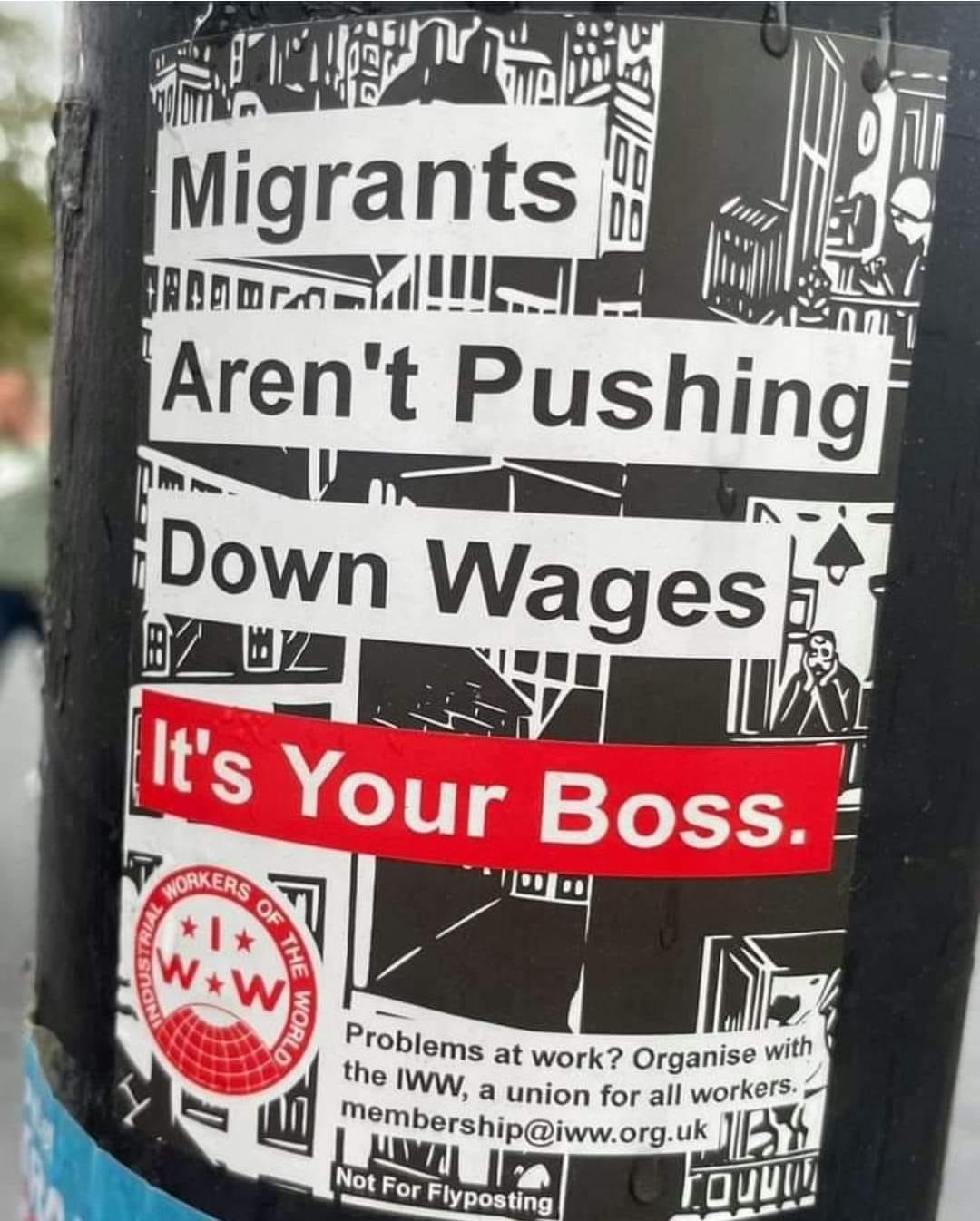
deleted by creator
There aren’t enough workers per retiree anymore. That’s why publicly traded companies have to do nasty things to keep their stock prices growing for said retirees. Remember, retirement funds are usually based on stock indexes, not bonds which are super slow growth.
We’ve been living in a system predicated on infinite growth. The old can retire because there are so many young people working. Now people live longer than ever (on average; not individually) and are having fewer kids than ever. Naturally the workers need to be exploited if the old people want to retire.
Migrants would actually be beneficial because they make the economy grow again.
And when people do stand up to ask for EVERYONE to receive what they should be given for their work, fare wages, affordable healthcare, half the nation screams at them, threatens to run them over, and says they must not have jobs because they can protest on a Saturday. They’re doing the work for the wealthy for free, busting up worker rights movements as a hobby, just to keep themselves poor and sick.
also keeping your population complacent, they wont riot or protest in any unified manner. thats why tiktok, enough wages/jobs, youtube, streamers. also to add in a little cultural wars as distraction in case the other doesnt work usually does the trick. it is the reason why the tech ceos, own children are kept away from social media, they dont want thier own children to be brainrotted.
They absolutely are pushing down wages, especially when they come from poor desperate countries, because they’re in a much more precarious financial position, they’re easier to exploit, less likely to join a union, and most importantly, more likely to work for lower wages.
Separating that, from the notion of racism or people getting mad at the immigrants, and not the elected officials creating the policies that allow your boss to import and exploit people from overseas, is important to working class success.
How did we get so easily baited into falling for this?
The point is, your boss could pay everyone, including them, as much as he always did, and more.
He specifically chooses to exploit this desperation and pay less, because the difference adds to his bottom line.
The anti-immigrant talks shift the blame from those who intentionally pay less to those who has to choose between a bad deal and starvation.
Elected officials won’t do anything about it until you force them to. And immigrants are your allies in this - they too are a workforce who needs better wages. Your interests are aligned.
You’re just straight up factually wrong. Immigration has either little effect, or in fact increases wages for native citizens.
Instead of making statements based on your feelings and how you think that things work, you should do a bare minimum amount of research beforehand.
https://cepr.org/voxeu/columns/revisiting-immigrations-effect-us-wages-and-employment
https://www.congress.gov/119/meeting/house/118767/documents/HHRG-119-JU01-20251217-SD001-U1.pdf
https://abic.us/facts-immigrants-arent-stealing-your-jobs-or-lowering-wages/
https://www.nber.org/papers/w32389
https://www.americanprogress.org/article/immigrants-make-the-labor-market-great/
Assuming there can only be a fixed number of jobs, you’re right. However, that’s like solving for spherical chickens in vacuum.
IWW is the greatest. I have their sticker in my front door window.
I love the idea of them, but do they actually wield much power anymore? I’ve heard of people trying to contact chapters and barely getting any responses, that kinda thing.
The state of unions is saddening. Would be cool if IWW is coming back, or has already come back in force.
It’s both, but boss is the biggest contributor of the two by far. I’ve worked for few owners, they hate payroll. It’s their biggest expense and that infuriates many of them. They despise paying anybody anything.
So, of course a huge amount pay the lowest wages possible, and a lot of them would own you as a slave if it was legal, no doubt. And they’d grumble about the cost of the gruel.
Government’s fundamental job is keeping the general population from being enslaved by these people. It’s what government is for.
It’s their biggest expense
I kinda doubt this is true for most businesses to be honest. It’s just the expense that most pisses them off.
It’s kinda like if you ever get into an argument with someone about US government spending. Many people believe military personnel is the biggest ticket item for the pentagon when it is not even close.
Many companies spend more on marketing (in house or more often outsourced) than they do on labor. But for some reason, labor is always what pisses them off.
We’ve been working for different types of companies then, because I’m going to have to agree with the other guy on payroll usually being the biggest. Definitely so for office type work, probably less so for industrial work where you need to buy a bunch of input goods.
To see why immigration is not a factor, see https://lemmy.world/post/53479187/26477182
No there the job creaters you moran!! [sic]
- people who simp for the billionaires
evidenced plainly by the fact that they’d invest 1.5+ trillion in the magical “I don’t need workers anymore” word guessing machine and keep doubling and tripling down upon it at the potential peril of the global economy
It is most certainly in the business’s interest to pay the absolute minimum possible
But is this not basic supply and demand? More people wanting a job pushes the price down, migrants are more people
Assuming there can only be a fixed number of jobs, you’re right. However, that’s like solving for spherical chickens in vacuum.
To see why immigration is not a factor, see https://lemmy.world/post/53479187/26477182
I can point to good studies and government modelling too that find immigration reduces wages, it’s a pointless internet battle…
The key difference between all the research is in the subgroups of workers compared and a few issues trying to study it:
-
Immigrants choose where to go, often to booming places, which can mask wage effects.
-
Natives and firms adjust (people move, capital flows in, jobs get reorganised), which dilutes local comparisons.
-
National-level studies avoid that problem but depend on modelling assumptions, such as how substitutable workers are.
This prompts the debate of skilled migrants vs unskilled, which leads to looking at how wages reduce or stagnate for professionals when there are high rates of skilled immigration aaaand we’re back at square one
You can point out a couple of flawed studies against a mountain of contrary evidence.
https://www.congress.gov/118/meeting/house/116727/documents/HHRG-118-JU01-20240111-SD013.pdf
Intro
Today, the United States is home to the largest immigrant population in the world. Even though immigrants assimilate faster in the United States compared to developed European nations, immigration policy has become a highly contentious issue in America. While much of the debate centers on cultural issues, the economic effects of immigration are clear: Economic analysis finds little support for the view that inflows of foreign labor have reduced jobs or Americans’ wages. Economic theory predictions and the bulk of academic research confirms that wages are unaffected by immigration over the long-term and that the economic effects of immigration are mostly positive for natives and for the overall economy.
Key points
While some policymakers have blamed immigration for slowing U.S. wage growth since the 1970s, most academic research finds little long run effect on Americans’ wages.
The available evidence suggests that immigration leads to more innovation, a better educated workforce, greater occupational specialization, better matching of skills with jobs, and higher overall economic productivity.
Immigration also has a net positive effect on combined federal, state, and local budgets. But not all taxpayers benefit equally. In regions with large populations of less educated, low-income immigrants, native-born residents bear significant net costs due to immigrants’ use of public services, especially education.
It’s pretty disgusting you’d try to use this misleading appeal to authority, attempting to frame this as some reputable government finding when it’s only just a third party document mirrored by the congress website. Let’s dive into the obvious problems here.
-
Unknown author and funding: No named author, no disclosure, no sign of peer review.
-
Advocacy-linked sources: Key claims cite Cato, NFAP (Stuart Anderson) and the Partnership for a New American Economy. All are policy advocacy organisations.
-
It’s 9 pages with no original analysis beyond a couple of charts. Its conclusions depend on a handful of studies chosen by the author.
-
Old data: It’s a 2016 brief using 2009-2013 figures, so it misses the post-2020 immigration surge, post-pandemic labour markets and recent fiscal studies.
-
“Economists generally agree”: The only support is a 2013 IGM expert poll in a footnote.
-
Contested findings downplayed: Borjas’s estimate that 1980-2000 immigration cut wages about 3% is footnoted, then treated as an outlier.
-
Static framing: It doesn’t model scenarios, uncertainty ranges or sensitivity to assumptions.
-
The brief’s chain of reasoning is that immigration adds labour supply, wages dip, firms invest more, capital per worker recovers, and so wages recover. Except no evidence is presented for wage recovery. The theory needs capital per worker to hold. Wages also depend on labour’s share of income, which the brief admits has fallen since 2000. It dismisses that in a footnote as “technology and globalisation”
-
The two studies in Table 2 are simulations that build in the investment response and imperfect substitutability between immigrants and natives. The roughly +0.5 percentage point result for native wages depends partly on those assumptions, so it is not an observed wage change.
I could go on but the fact you’re trying to claim this very misleading report produced by lobbyists is reputable is insane. If anything, it strongly supports immigration causing immediate dip in wages. They have a theoretical simulated scenario to suggest wages might improve afterwards.
It is a peer reviewed non-partisan Congressional report about the country with the most immigrants in the world. Clearly you are much smarter than these experts.
With ALL key sources being policy advocates?
Stop pretending and go shovel your AI slop somewhere else.
-
Ya, that’s the point - for a particular designation, the wage will have downward pressure, but for workers as whole the distribution of wages gets an upward pressure.
The first part is obvious and proven, but the second part is hotly contested
Oh you seem overly confident about studies confirming your beliefs and doubtful on those that do not
-
More people isn’t just more supply, it’s also more demand. More people means more customers.
What about when they’re temporary, and go back home with their money?
What about when they come from a country so desperate and poor that they’re terrified of being forced to go back, and so they’ll do anything for work, even work half of minimum wage? You don’t think that might drive down wages?
What if they’re so terrified that they won’t form a union? Shouldn’t the IWW care about that?
What if this is all a trick by the capitalists themselves?
What about when they’re temporary, and go back home with their money?
That’s not an “immigrant”, that’s a seasonal migrant worker. Typically not legally capable of competing with legal citizens. They’re picking fruit, not edging you out of a Target cashier job, much less anything else. If they’re actual immigrants, and not seasonal workers, this is home.
What about when they come from a country so desperate and poor that they’re terrified of being forced to go back, and so they’ll do anything for work, even work half of minimum wage? You don’t think that might drive down wages?
If they live here, they live here. If they’re legally able to apply to jobs that pay above minimum wage, why would they be forced to go back? Are there any employment-dependent visas for minimum wage work? I’m certainly not aware of any.
What if they’re so terrified that they won’t form a union? Shouldn’t the IWW care about that?
What?
What if this is all a trick by the capitalists themselves?
Immigration? I mean yeah, they’re the driving force behind seasonal migrant workers. But actual immigrants?
There are very few businesses that increase staffing 1:1 proportionally with customers
And? I’m talking broadly about the economy, not one particular business.
That’s just deflecting from the fact that more people job seeking means lower wages, without even considering that people moving from poorer countries will typically work for less
How is that a deflection? It’s a direct refutation of your central point.
When a person moves in and takes a job at a grocery store, they aren’t just a customer for the grocery store. They are a customer for clothing stores, movie theaters, appliance stores, barbers, restaurants, mechanics, etc.
To simplify things to “basic supply and demand” levels: if you have 20 businesses in town which each staff at a 1:20 ratio, 20 migrants moving into town and shopping at those businesses, increases supply exactly in proportion to the increase in demand.
It’s reductive, but then “basic supply and demand” is itself extremely reductive. It’s a drastic simplification to illustrate basic concepts, like frictionless surfaces and spherical cows in Physics 101. “Basic supply and demand” is not how economies actually work, it’s a simplified model for Econ 101.
But then you’re being reductive, because that person could very well just be taking their money back home with them. Because as you say, it’s not just as simple as that. The person above you has a point.
But then you’re being reductive
Yes, I explicitly said so. Almost as reductive as “basic supply and demand” arguments. Almost.
Because as you say, it’s not just as simple as that. The person above you has a point.
On the contrary, that only proves my overarching point that actual economics is more complicated than “basic supply and demand”.
What you’re describing is relatively common among seasonal workers, but that’s an entirely different can of worms than normal migrants. Seasonal migrant workers are not competing against locals for jobs, because locals aren’t applying for those jobs, which is why there’s a market for seasonal migrant workers in the first place.
If they’re taking their money back home with them, they aren’t really the immigrants we’re talking about. Immigrants are people who have made this their new home.
And again, those people are doing jobs locals don’t want. They aren’t seeking citizenship and applying for normal jobs, they’re moving here for a season to pick fruit under the table. Locals are not competing for those jobs.
But again, it’s a complicated system. “Basic supply and demand” is basically irrelevant outside the classroom. Sure it’s one of many factors, but it’s not the ultimate truth in a rational understanding of actual economics. It’s a spherical cow.
lol really? Cheap labors drives down wages.
The point is, who drives down wages? They don’t fall down automatically.
(Spoiler: it’s your boss, he’s the problem)
To see why immigration is not a factor, see https://lemmy.world/post/53479187/26477182
Yeah this poster is idiotic and hopefully not real. My boss and my government is the problem, for hiring and exploiting the migrant workers who are so desperate that they will work for lower wages.
If we fix the laws so that there aren’t so many desperate poor people to import and exploit, we could solve this problem.
But the IWW is captured and corrupt so it makes sense they would make this.
True!
In my experience, no, it’s not your boss at all, it’s the C-Suite. In the overwhelming majority of companies, the people who are 2-3 levels of management above frontline staff have little to nothing to do with setting wages
Want higher wages? Support legislation to enact a global minimum wage and/or legalize unionization. Blaming individual bosses is futile.
Often times it’s your boss’ boss’ boss.
This isn’t quite how it works. Generally in medium to large businesses - meaning at least a billion a year in annual revenue - oftentimes how it works is a given business unit (BU) will be given a budget. This is usually based on analysis and projections based on the previous fiscal years as well as projections on growth goals.
The VP of that BU will need to spread that budget across their unit as best they can. This will include everything from promotions to new hires. Keep in mind that it could cost a business $160 an hour to hire one full time employee who only makes $50 an hour, all things depending. In many roles, it can take a year or more to get a new hire up to speed in their new role. At $160 an hour, that’s $332,800 against your budget and that first year will not recoup 100% of the potential output of that new hire who will likely not be putting out their fullest until around a year or more, so you’re looking at what more or less accounts to over a quarter of a million just to train a new employee for one year so they can start putting out the same level of work as someone of their level should be.
Then consider if you’re an international company. The business I work for for example is in 60 different countries. All of those countries have different regulatory practices that require a lot out of the HR business unit(s). Some countries have regulatory requirements that force the business to utilize software that can account for those regulations that cost millions annually and aren’t even very good, but there isn’t a good alternative, so it’s either pay that or fall out of compliance, which is not really a viable strategy.
If you have 100 employees in your unit and you want to give them all a 3% annual raise but you’re not given a larger budget unless you grow that side of the business (in other words, you self fund), then where are you getting that revenue stream from?
In many cases you have to set up projects yourself from the top-down, such as requesting from your directors that they begin brainstorming ways to generate revenue. This could be through efficiencies, for example. If you were a director in HR for example, maybe you want to take a look at your team’s processes and see what could be automated. That project alone requires expertise, and those kinds of analysts aren’t cheap. Then you need engineers to perform the automation, which are also not cheap, and you need a surefire return on investment there because the end goal might be to free up 25% of your team’s labor through automation of their current processes, but you may not see a return on investment for 2 years, then by the third year the return isn’t even enough to hire an additional 3 people, let alone give an entire team of 100 a 3% raise.
So you might argue then, “well why can’t the business just give that BU a larger budget?” And there are a few answers. I won’t list them all here, but some examples would be is there something your team could be doing to increase their value to warrant taking budget from elsewhere to funnel into your team? Or every year is it just expected that 3% of the budget go into the employees without an ounce of those employees providing any additional value? To seriously simplify, if the business makes $100 and they pay $50 to their employees and $30 to their shareholders and $20 is reinvested in the company, why should the business pay the employees 60%? HOW do they pay them 60%? They have to take it from the shareholders or the reinvestment, and take too much from the reinvestment and your competition will put you out of business, and take too much from the shareholders and they will invest with your competitors - see the problem?
Many employees don’t understand that they have to increase their perceived value to warrant more, and few do.
I read all of this. Thanks for writing it all up from your experience.
That said…geeze if it’s so awfully expensive to take such a huge risk on employees…can I just get affordable and adequate education so I can do my own thing instead of being part of a “business unit” forever trying to increase my Sisyphian “perceived value” to infinite heights until I expire?
That’d be cool. Because the business unit “starved rats eating each other in a cage for budget money thing” sounds pretty awful.
I’ve never been paid $50 an hour for anything though. (I know, not with that attitude, right? Lol) Maybe it starts to feel worth it at that point?
Maybe I’m just naive and behind though. I still can’t understand why people accept “salary” to basically be owned by their boss/corpo, especially in the U.S.
Can be called in any time and never get overtime? That very idea sounds like a way to sidestep labor rights to me.
I’ve heard of fabled lands far away where the relationship is far less antagonistic and employers value and take care of their employees who, in turn, genuinely enjoy striving for their workplace’s success. . .but here? Ha. Maybe in those fun days where joining a tech giant made you 250k a year or something.
I’ve actually fought my entire life against the “game” of business. I don’t like the lingo, I don’t like the corporate nonsense, and I don’t like how business in general is conducted. I mostly work by myself. I’ve simply learned some skills that let me produce value for businesses so they want to give me a paycheck, but even then it’s always an ongoing challenge because anyone can be removed from a role at any time and for any reason.
Oh cry me a river. Large companies are profitable enough, and it does not take one year to get an employee up to speed. The fact that the BU unit’s budget is so limited is because the money is flowing to the investors, that’s all. And that’s your boss’ boss’ boss.
I work high up in large business, so I know how it works.
Let’s say you’re correct, so what? Let’s say I have $10,000 to invest. I notice that the electronics sector is a good place to invest based upon recent trends, so I want to invest there. I do some research and conclude I will either invest in Apple, or Samsung.
If I choose Apple and they give me a 5% return on investment but Samsung gives me 8%, I will invest with Samsung. My money isn’t a charity, it’s an investment.
I am relying on the company to do the best job that they can to provide me with a return on my investment because I would actually LOSE money on my investment, and if I keep losing money, that would be quite irrational of me to keep investing, wouldn’t it?
And if Samsung ends up getting 70% of the investment and Apple only 30%, Apple is going to go out of business, and it should. This would fundamentally mean that Samsung is the superior business in that sector and Apple is doing so poorly that it should not exist.
Investors by the way do not obtain a fixed percentage of profit from a company’s income statement. What they receive depends on a myriad of things like earnings through dividends, equity appreciation, interest rates, type of investments, etc.
Publicly traded companies have benefits over private. They for instance, can produce large amounts of money through selling stock or bond issuing, and shareholders being able to easily buy/sell shares gives good data on company value. Private businesses on the other hand often have more limit on raising funds, so it can make it very challenging, if not impossible, for private companies in some sectors to compete with publicly traded ones. Keep in mind it’s also more complicated than that.
I can give you an example from my business life as well. About 5 years ago a mid-market business (let’s just say around 5 billion in annual revenue) was bought by a private equity firm. The reason was the business was failing. If not for private equity, the business likely would have died.
Through private equity and their investor base, the business is still afloat and doing even better. Private equity was able to invest in the business to make it more profitable, but they don’t want to do that with nothing to gain. The goal in that investment is they make enough of a return in the future that they made a profit off the endeavor. It’s a risk - the firm could have invested billions only to see nothing but a loss. Do that too often and the entire firm would fail and thus, close.
A lot of terminations were done too, but new people were also brought in and a lot of changes were made.
But without giving to that investment, the business would have failed and 100% of its employees would have been without a job. This business currently employs over 10,000 people, mind you.
I have worked as an exec in a division of a multi billion dollar business, and in many a startup.
Often times it’s your boss’ boss’ boss.
Marx to Kugelmann, 1870:
The average English worker hates the Irish worker as a competitor who lowers wages and the standard of life. […] He regards him practically in the same way the poor whites in the southern states of North America regard the black slaves. This antagonism between the proletarians in England is artificially nourished and kept alive by the bourgeoisie. It knows that this split is the true secret of maintaining its power. […] Finally, England today is seeing a repetition of what happened on a gigantic scale in ancient Rome. A nation that enslaves another forges its own chains.
Time is a flat circle. History repeats and rhymes because the constant is humanity.
A nation that enslaves another forges its own chains.
The reason why Americans don’t do anything. The United States is the modern English empire.
Every worker should be a part of a union. It is worth it to have some one on your side in negotiations.
Industrial unions ran by activist kids from the city aren’t workers unions. They’re just leeching
laughs as a wobbly himself. we legit help local folks get strong enough to transition into “real” unions.
Not if you’re supporting policies that import scab labour you’re not.
and what policies are those? no scabs here, that im aware of.
Describe the problem and how to avoid it. Otherwise you’re just a fucking scum-sucking fuckhead defeatist loser like everyone else who pretended they had a point.
Your ideas don’t have to be sound. Though they must demonstrate your willingness to abandon the status quo.
So tell us; Is your mind greater than the status quo, or not?
rofl… “you cannot be a real union; there are no rich kids amongst you!”
… You’re a fucking clown.
I said the opposite you fucking spoon
I believe “activist kids from the city” means he’s calling the IWW the rich kids.
So activists are all entitled and can be dismissed as a whole?
So nothing rich fuckheads say has power until they’re past dead?
Both aspects bear meaning, but only one side of the coin bears extra suffering.
What?
One would expect an industrial workers union to have industrial workers in the union. Given they pay a % of their paychecks you’d also expect that industrial workers are to be the centre focus. Except when you go to their website it’s countless photos of activist kids protesting things completely unrelated to industrial workers unionisation. I dont think I saw a single photo of anything remotely industrial but many photos of soft handed people holding signs in a central city park.
When I was in a trade union the people running it werent kids out of college. It was wives of trades or retired tradies. The focus wasnt socialism, wasnt leftism, wasnt isreal Palestine. It was certifications, standard pay rates and working conditions.
The whole thing is a scam. Go through their site they have like 5 articles registering the same small book stores and cafes. My local branch is a fucking joke not a single actual thing about unions they just want people to do their communist revolution larp.
Alright, I appreciate that instead of union activity, they’re into political activity. When you said ‘soft handed’, did you mean those who do no work need not have union, or those employed in clerical work do not deserve union? A sickle/hammer chauvinism over keyboard?
Why on earth would you think I’m saying those who do no work dont need a union or clerical work doesnt deserve a union. Seems like you’re intentionally missing the point.
Just wanted to know what you meant by ‘soft handed’ and why you brought that up?
People who work with their hands vs people who dont.
Given that their whole union is based on industrial workers its pretty weird for them to not be industrial workers or adjacent in anyway. Im pretty sure this is a scam.
So, if it were called something like ‘All Workers Union’, it’s alright?