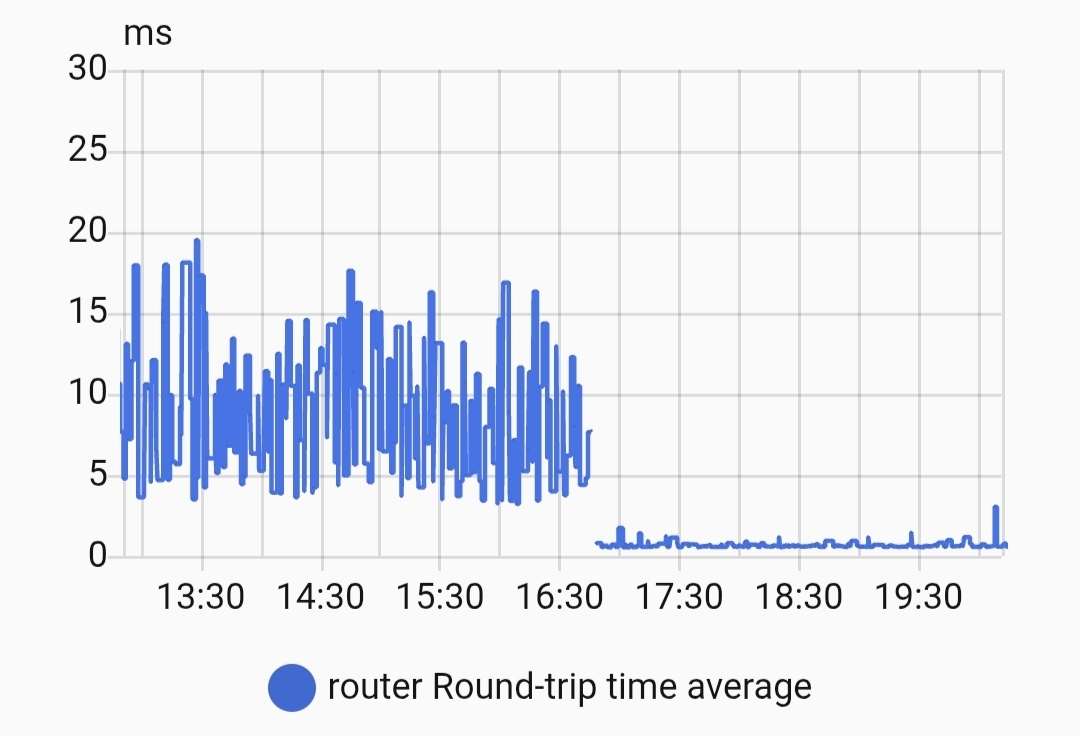
Homeplugs (ethernet over power) are fine for some things, but they add so much latency to the network.
Wired is so much better.
You must log in or # to comment.
As a network guy: Ethernet over power lines can be fine, but you basically need to be an electrician, and have a working knowledge of how powerline Ethernet works before you can get there.
Even if you do, or stumble into a working setup by accident, you can absolutely end up with all kinds of bad things happening because power lines are notoriously bad with crosstalk and EMI, both on the wire and emitted from it.
If you absolutely cannot do rj45/Ethernet runs, and WiFi isn’t viable for whatever reason (or even if it is), look into MoCA. Thank me later.
It won’t cost you any more than powerline, and you’ll get a cleaner signal, more consistent performance, and overall a better experience.
In order of preference, I prefer the following connection options:
- fiber
- Ethernet
- MoCA
- Wi-Fi
- powerline
Fiber, not because it’s faster or better (there are many ways it’s actually worse than Ethernet), but because it’s almost impossible to interfere with, unless someone physically disconnects the cable (or breaks/cuts it). As long as the line is protected from damage, it will give the most consistent performance.
Ethernet, more robust than fiber in terms of physical disability, can be faster at propagating data (the time it takes to get from one end of the cable to the other), but only works over relatively short runs (100m or less, by spec), and it’s susceptible to alien interference and crosstalk. However, it is far more rugged than fiber.
MoCA is half duplex but shares a lot of the benefits of Ethernet. The main improvement here is that coax is commonly present in most homes already, while Ethernet is relatively uncommon in homes, so many homes are already wired in a way that works with MoCA.
Wi-Fi is also half duplex, it can go faster than Ethernet under the right conditions (which are almost impossible to achieve in real world conditions). Propagation is as fast as Ethernet but it has more overhead, and it is much more prone to interference from other Wi-Fi networks or other things operating on the same, unlicensed, bands.
Powerline should only be considered if all of the other options are disqualified for some reason.
Also, anyone using wifi extenders (not talking about mesh or anything, just actual Wi-Fi extenders), should probably not be doing that. Wi-Fi extenders are often just retransmitting the packets on the same wifi channel, which dramatically cuts the available bandwidth. You’ll end up with a stronger connection, but a much slower one.
Thank you for coming to my Ted talk.
The only thing they are good at doing is producing loads of RFI and pissing off every ham radio operator in the area.
One of the best no-noise locations I ever did was in a fully powered-down sailboat in the southern lagoon at Fort Jefferson, Dry Tortugas. Leaky consumer electronics are the worst.
To contrast, I managed to work Indonesia from Alamogordo NM despite being in a residential neighborhood, HVAC capacitors and foreign over-the-horizon-radar (OTHR) be damned. Taught me a lot about being patient and picking out transmissions in the noise.
I mean does anyone go for power line adapters as their first choice when straight up ethernet is an option?
The number of people that are anti wires, but also want WiFi signals everywhere is too high.
Powerline is so leaky it is basically wireless with wires. 14x3 is not a transmission line, but it does effectively turn your whole home electrical system into both a transmitting and receiving antenna that just happens to talk to it’s self. It’s an engineering nightmare.