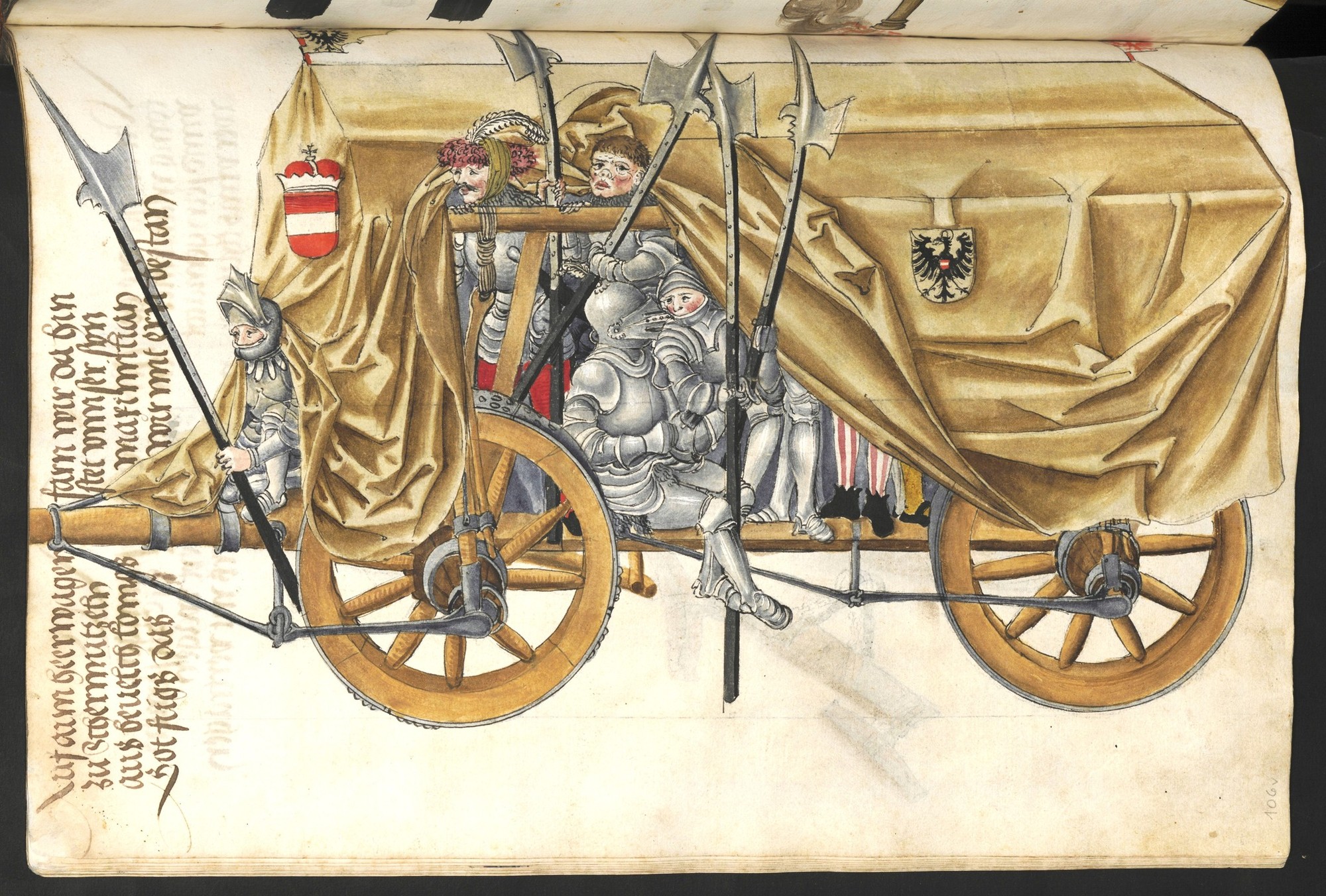
That’s incredible.
Would monks (or whoever) actually try to copy something like that, in producing more editions?
There would be specialists who did the artwork, specifically, at this point in history. I think they had a form of tracing using an original/template illustration, but I only vaguely remember my art history classes.
I couldn’t find much about this specific one, but decided to throw the reproduction issue out to GPT5.2, FWIW.
https://chatgpt.com/share/699fe012-a948-800b-a97f-949bd5d92650
Grids and lightboxes are some classic art reproduction methods, so that makes a lot of sense. “Pricking and pouncing” seem to check out with some searching, and evidently they also used “pouncing wheels” to facilitate that, also classically used in transferring patterns in sewing.
This all kind of interests me particularly, as a part-time artist.
What, in full armour? Haven’t I been told numerous times that what we think of as a “knight’s armour” usually makes it hard to impossible to move around unless on horse? These look like a pain to even get up.
(The text is infuriating, it looks just familiar enough to make me think I could read and with a bit of effort understand it if they simply used a different, less quirky font)
Edit: apparently some people take issue with me being confused and asking a question to see what I misunderstood. Nice.
Full plate armor is really agile, not cumbersome. You don’t make a soldier less agile when you armor him, that would be suicidal.
Moving around is fine - you can run, jump, spin, do whatever you like, in full armor like that. It’s something like ~30 pounds, which is bad, but not deabilitating,
The issue that arises is fatigue - it’s horrible to make a march in, and takes time to take on and off. So while there would often be a core of heavy infantry outfitted like this, most infantry would prefer lighter armor.
The only armor that would be legitimately unable to be used on foot would be jousting armor, which was immensely heavy because it was meant to protect the user entirely during sport (the, well, joust).
Yeah, I did suspect that I’m simply not knowledgeable enough about different types of armour. Learnt another new thing, yay :D
Yeah, jousting armor can reach like, triple that weight, or more. THAT sort of thing you definitely won’t be going anywhere on foot with, lmao.
People who practice HEMA in armor or Bohurt can be frighteningly fast even in all that gear.
Also it’s 15 kilos spread out over your whole body, not just one part. That alone makes it way easier to deal with the weigh. But 15 kilos isn’t a ton of weight for a soldier anyways. It’s about what my battle rattle was in the army but mine was all on my torso.
I like language so it’s fun to see how close to and yet how far this still is from modern German but I’m losing hair over this guy’s
choice of fonthand writing.Auf aim(lolwat?)
gheerwagen farn wir da hinzu sch
aermutzeln…aus … maximilian
Got fugs das wir mit ern
…bestanThey’re going somewhere on
a wagon carrying weapons(nope, not “geer”, that’s “heer”, stop guessing) an army wagon to fight someone, probably for Maximilian (who seems to have owned this manuscript according to the additional data), and they’re petitioning God to make it so theydo something (probably fight and get back home)win honourably.It’s like I’m so close to being able to read it and then it gives me squiggly nonsense lines and quirky spelling, just to trip up me specifically and in particular. /c/mildlyinfuriating
Edit: three edits in, I’m on to you, Kumpel
I can read
zu schaermutzeln stet unser sin
Oh shi- I see it. Nice!!
The armor was constructed so people could be agile in it. The goal was to protect the wearer while still allowing him to fight.
Also when the “Knight” was still a military role these people had extensive training regimes.
Daniel Jaquet has a nice demonstration up on his youtube.
https://www.youtube.com/watch?v=pAzI1UvlQqw
I think he also ran a half marathon in armor.