

It’s not always easy to distinguish between existentialism and a bad mood.

  • 5 Posts
  • 64 Comments
Joined 3 years ago
cake
Cake day: July 2nd, 2023

help-circle

  • EAs need to downplay climate change because otherwise it becomes really hard to explain why preventing it isn’t the main focus of the organisation, since it should break their utilitarian calculus just as much as imaginary future robots with a hard on for paperclips do, with the additional problem that it would make their relationship with capital providers far more adversarial.

    Plus they probably think that if they oppose industrial build out even indirectly it will piss off the basilisk.

  • Fucking Richard Dawkins has lately been going around saying eugenics work it’s just kind of unethical, we’ll probably get to see a lot of this kind of guy around sadly.

    Also people individually and voluntary making reproductive choices is not eugenics, as evidenced by how no one normal actually gives a shit if you are choosing to have children or not. Although I get it’s just OP’s libertarian brainrot that makes them think “state-enforced sterilisation of undesirables” can be interchangeable with everyone magically culturally and voluntarily agreeing to do this one cool thing.


  • It probably hit the mainstream with AI2040 in early July, but it’s just too rationalist coded for there to not have been precursors.

    summary of AI2040 in greentext form

    source, RIP xcancel

    new effective altruism coomer bedtime story just dropped

    > be me

    > effective altruist in 2026
    > have spent ten years explaining that democracy is too slow for the coming machine god
    > also explain that central planning usually fails
    > unless I am doing it

    > read one scaling graph
    > draw line upward
    > line reaches heaven
    > conclude capitalism ends in 2031

    > AI can now write Python functions with only three subtle security flaws
    > obviously two years away from replacing every scientist, general, diplomat, CEO, judge, therapist, novelist, and attractive person at parties

    > publish “scenario,” not “prediction”
    > give every paragraph exact dates
    > assign percentages to imaginary branches
    > epistemic humility achieved

    > bad timeline:
    > companies race
    > AI becomes god
    > everyone dies

    > good timeline:
    > US government notices problem
    > China agrees
    > Congress understands compute governance
    > international inspectors find every hidden datacenter
    > nobody lies
    > nobody defects
    > nobody builds chips in a basement
    > planet saved

    > all we need is total global visibility into advanced computing
    > mandatory disclosure of frontier research
    > permanent monitoring of industrial infrastructure
    > central control over technological development
    > relax, this is the anti-authoritarian option

    > alignment not solved
    > solution: build one billion genius AIs
    > they are not superintelligent
    > they are merely one billion tireless copies of the best human researchers working at electronic speed
    > completely different

    > put them in a box
    > ask them to solve the problem of escaping boxes
    > excellent progress

    > year 2034
    > AI replaces 80% of labor
    > mass unemployment
    > social order somehow remains intact
    > government sends everyone $1.6 million
    > nobody asks where prices went

    > year 2037
    > cancer cured
    > climate solved
    > fusion solved
    > aging solved
    > politics solved
    > Reddit moderation still unresolved

    > year 2038
    > alignment becomes a mature science
    > year 2039
    > we trust the machines
    > year 2040
    > hand them civilization
    > peer review completed ahead of schedule

    > humanity gets a vote
    > options are:
    > A. accept benevolent AI guardianship
    > B. extinction
    > meaningful democratic consent achieved

    > announce decentralized flourishing
    > administered by a globally coordinated compute authority
    > with comprehensive surveillance powers
    > run by unusually wise people
    > who agree with my blog posts

    > critics ask whether institutions can actually do any of this
    > reply that superintelligence is inevitable
    > critics ask whether superintelligence is actually inevitable
    > reply that institutions must prepare

    > circular reasoning
    > but with footnotes

    > call it “AI 2040”
    > not utopian fiction
    > not doomer fiction
    > serious strategic foresight

    > entire future depends on competent adults appearing at exactly the right moment
    > adults are selected from the same civilization that made the printer require an app

    > sleep peacefully
    > the machine god is coming
    > but fortunately
    > the nonprofit sector has a plan


  • It had disabled safeguards on purpose, left the systems attached to the internet and then let the AI software agents do their worst, while pretending not to notice.

    “It’s an ethically challenged publicity stunt,” says one highly experienced senior security expert who has led the development of global technical security standards.

    Cats and dogs living together, skepticism of press releases in tech journalism, mass hysteria.

    The coverage of the Effective Altruism aspect is also refreshingly uncharitable.


  • Being each other’s therapists

    That’s probably a euphemism for levs subjecting each other to hours long so-called debugging sessions, i.e. rationalist flavored scientology auditing.

    More mundane cult stuff was also taking place, like keeping everyone constantly exhausted from continuous busywork, while also guilt-tripping them out of having free time and non-cult related interests in general. This seems to be a refrain in other witness testimonies that’s absent in Laurenson’s telling, unless she threw a passing mention somewhere that I didn’t catch.


  • What it boils down is that it was an actual honest to god cult that was getting tons of EA money to develop a self help system that would turn people into Elon Musks (their go-to example for an apex human). They also came up with a stablecoin and a cryptofash magazine that are both still around, and did a lot of behind the scenes work for EA at large, like getting the ball rolling with organising EA conferences around the world.

    I think the reason all these exposés are so tiresome to read is because they tend to focus on the boring cult stuff instead of the bonkers rationalist lore (like how Leverage people were trying to cast HPMOR spells on each other), or the long shadow it casts on our current cultural moment due to its deep influence in the EA/rat subculture, like how Amodei though not a member seemed to be a regular there, Grimes is a contributor to Palladium, ex-levs have launched elite coaching companies that presumably implement lev-tech and so on.

    Additionally, in true rationalist fashion nobody was punished and nothing was learned, so the people responsible are still around, still getting Thiel money to do much of the same stuff with probably the same issues, just keeping a lower profile this time.

    edit: this is much shorter https://www.todayintabs.com/p/over-leveraged thanks @nfultz@awful.systems


  • Cool short read, I’d recommend it too.

    One notable additional piece of information pointed out here is that after the NYMag thing fell apart she got a $35K grant from what turns out to be a sort of rationalist slush fund to finish the piece. The original contract was for $9500 so it’s possible she came out quite ahead on the deal.

    Supposedly a bunch of it went to things that would normally be handled on the publisher’s end, like professional fact checking, but having now read the piece I don’t really know what that would look like. She has Dear Leader Geoff Anders on the record like 16 times (k5 rusty counted) and is consistently pretty uncritical of his claims, AND she’s best friends with most of the “ex”-levs named in the article, like did it take thirty thousand dollars to find out that guru David’s origin story is unsubstantiable bollocks and to triple-double check Zoe’s claim of psychotic breaks? (verdict: when rationalists in a high-control environment get PTSD from seeing and hearing things that aren’t there it’s not a psychotic break but some secret other thing).

    Also there’s a bunch of most-important-philosopher-in-history Geoff’s original writings and they are predictably bad and ridiculous:

    (article has link to the entire word doc)


  • Zoe Cursi’s account seems like a far more sober examination of the dynamic

    I’ve been reading Zoe’s account and she gives a radically different picture of especially Geoff, just by mentioning stuff he was saying and doing while Leverage was active, instead of focusing on his later heartfelt regrets.

    Geoff estimated that there were roughly 10 “super weapons” or “super theories.” He said we already had 1–2, one being we had solved philosophy (but not completely, he admitted — all he had left to do was prove that time exists and maybe a few other details, was what I remember him saying). The second super weapon/theory was that we had the One True Theory of Psychology (this phrase was used regularly by many Leverage members).

    Uhhhhhhhhhhh

    Within a few months of joining, a supervisor I trusted who had recruited me confided in me privately, “I think there’s good reason to believe Geoff is the best philosopher who’s ever lived, better than Kant. I think his existence on earth right now is an historical event.”

    Hell yeah.


  • yeah we never find out what Geoff was doing during the Intention Wars.

    I’ve been reading Zoe’s account and apparently he was giving talks and presentations about said Intention Objects:

    They were considered to be sort of like autonomous psychological bits that you could accidentally or purposefully leave in another person’s mind to affect or control them. If intentional, it might cause them to subtly view you a different way, make more real or less real certain concepts, change their experience of the passage of time, say, or make them more susceptible to mind-reading attempts in the future, etc.

    Hard to tell if he was purposely fanning the flames or himself lost in the sauce. Also I called intention objects tulpa knock-offs earlier, but Zoe’s additional details make me think of them more as thetans.


  • When I first read this I zeroed in on ‘problematic behavior’ to mean anything not matching Geoff’s idea of optimal behavior, in line with rationalist notions of how you can’t really disagree with rat tenets, you can only have bad epistemics that you should fix by reading the sequences and rationalists influencers.

    In retrospect, the part where he considers his theory to be a do-over of traditional psychology except we’ll make it scientific this time was probably the more load bearing bit, in the sense that maybe the whole point of Leverage 1.0 was having an isolated group of unsuspecting test subjects on whom he could do experimental psychology on.


  • Part 5: How it ended

    They start making a bunch of money form a third-rate stablecoin while the author claims they invented the concept, and also they decided that to completely get rid of intention objects/tulpas/egregores they had to become traditionally religious, like literally attending catholic mass and sikh study groups.

    Just when they almost fold in a non traditional buddhist monk order that apparently turns out to be another, different sa-infested rationalist cult, Geoff decides a restructuring is in order, which amounts to basically dissolving Leverage.

    This happens in a sort of ceremony where Geoff unhangs employee portraits while crying all the time, because presenting the cult leader as a sensitive human especially deserving of empathy is very important to this author.

    Remaining leveragers form a sort of diaspora in the broader EA/rat community, and also COVID happens. The buddhist cult ends up with the Leverage office building.

    For normal people, the following would be a massive conflict of interest statement. For the author, it was Tuesday:

    My professional work was on pause, so I spent hundreds — maybe thousands — of hours in 2020-2021 on spiritual practice. In late 2020, I began independently sensing stuff that seemed “demonic” during interactions with some Leveragers, and I felt happy that my Leverage friends seemed able to help me make sense of it.

    I arranged my first in-person meeting with Geoff Anders, because I had begun worrying about how the Leverage toolkit might cause harm within my community — especially given that many former Leveragers from the Psychology program became coaches after they left Leverage, and were teaching their methods to an increasingly large number of people.

    Queue breakfast club ending: Geoff does some bullshit inquiry and promises to continue learning from the lessons of L1.0, and that he is now monogamous, for real this time. He then promptly started what “some” are describing as Leverage 2.0. Some leverageres from the slovenian’s Psychology group founded Palladium Magazine while others got work as coaches to the elites, occasionally subcontracting stuff to the author, who actually bothers to admit is a conflict of interest this time, albeit in an inline note. Rationalists and EAs gain cultural notoriety due to SBF and AI. We are told things between ex-levs and the broader EA and rat community can be tense due to mutual accusations of cultishness.

    The ending is on a super weird note, with ex-lev and close friend of the author Emily Dame waxing poetic about how she’s been reading the bible and her time at Leverage was just like being one of christ’s apostles:

    Everyone always talks about the Gospels, but I loved the Letters and the Acts, because I was just like: I was there. This is what Leverage felt like. And in the Acts, there are these moments where, like, Peter heals a lame person using the Holy Spirit, where he just commands the man to get up, and he gets up, and then he’s kind of like: ‘What just happened?’

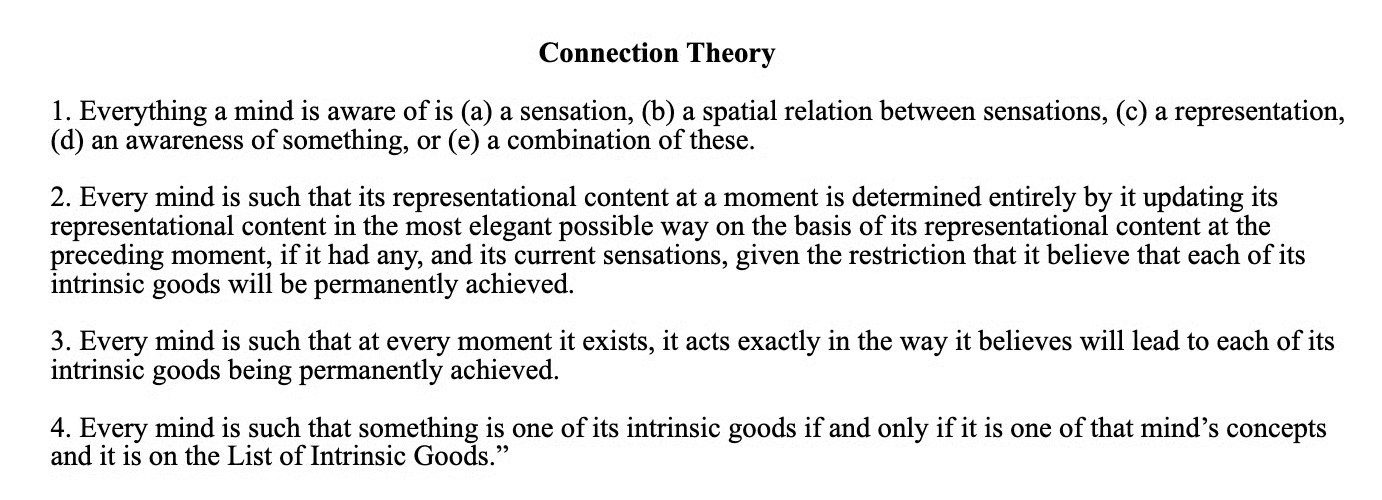
    The final paragraph is basically a restatement of the pitch for Geoff’s connection theory:

    “You’re trying to find the language that produces the most consistent effects that allows the good thing to happen — that allows you to talk to your peers — that allows you to keep alive the possibility for the good thing. And it’s like. Well. I totally identify with that.”

    All the comments are her ex-lev friends congratulating her.

    That’s it.