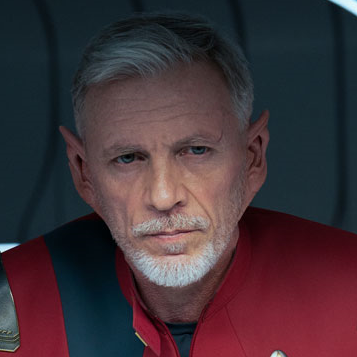

A visiting instructor arrives at the Academy and uses an unorthodox method to help our cadets process the emotions of recent trauma. At the same time, a cadet faces an unexpected challenge that will alter the trajectory of her life forever.
Written by: Gaia Violo & Jane Maggs
Directed by: Andi Armaganian
There is no spoiler protection in the episode discussion threads, and spoiler tags are not necessary!

I literally spent the whole episode whispering “don’t kill SAM, don’t kill SAM” to myself
Considering her half Lanthanite heritage with a long lifespan, I was left wondering why Ake also didn’t stay to raise Sam in the time dilated planet. They never address it, but I suppose it’s just unspokenly weird to suggest to co-parent a child with your subordinate coworker.
“The only thing that allows me to bear my infinity is not having to love anyone” may be one of the most devastating lines I’ve ever heard.
Hoo boy, that hit me harder than I expected. We’re rewatching Disco at the moment, and Tilly ranks high for me in that show. My partner squees almost every time SAM is on screen, so having both of these ladies in focus was a high point.
The theme of overcoming traumatic loss, both among the students and in the Doctor’s withdrawal from personal connections… it brought up stuff from my own life, and I think the lessons conveyed in this episode were very considerate and well formulated. Healing through art and drama, huh? Thanks for that, Trek ❤️🖖
This show continues to go in unexpected directions, and digging deep in more ways than one. Very welcome after a few years where the most interesting talking point about current Star Trek has been the captain’s quiff.
10/10. No notes.
In my view, perhaps the strongest episode yet.
Just goes to show that YMMV remains a truism.
I wonder why the old TOS fans like me are less impatient with fundamentals of human existence being presented through the growth of young adults?
Sincerely, resilience in the face of trauma is something many 30 and 40 year olds struggle with. I didn’t see this as sophomoric at all.
So, I wonder why episodes like this aren’t landing as well for folks 20 or even 30 years younger than I…
I don’t have any issue with seeing young adults growing and dealing with trauma. This episode has a lot of pieces working together in the overall storyline, I just don’t think it was that compelling within the episode.
The drama class half of the episode didn’t really go off. Maybe because I only know the play from what the episode told me about it, but I think it’s more like the actual growth part got cut off. We spend time with drunk Tarima (yawn) and then short cut the cadets actually performing the play with each other. That would have been the climax of that story, them getting into character, relating to it, working through it and reaching some sort of understanding or catharsis but that scene gets hand waved. Probably needed a full 45 minutes to do right too.
Or the Sam story, which was closer to the mark but still failed to create tension or consequences and ended up getting resolved neatly with a happy ending. Give Sam half an episode to be dead, for people to be sad, and the Doctor half an episode to reflect on it, resolving to do better before tying it up with a bow and it could have been great.
I love that the show isn’t constantly balls to the wall action and we’re getting a lot of character focus but the story juggling bit this episode in the ass and it isn’t the first to be trying to do too much and fumble the execution.
I only know the play from what the episode told me about it
I was unfamiliar with it too, but I feel like I got what I needed to from the description.
I unfortunately found Tarima’s messy response to her trauma very…familiar, on multiple levels.
The reactions all around were well done and in a quite relatable way. Many memories of my own youth as well.
I wonder why the old TOS fans like me are less impatient with fundamentals of human existence being presented through the growth of young adults?
I’m a TNG person myself. One thing that I very much liked about TNG, DS9, SNW, and to an extent VOY was the competency porn. (And then totally inverted in LDK)
This show doesn’t have much of that. It doesn’t even have what ENT had, which learning to be the professionals we want to see. This is still kids learning to be adults. That’s a different journey entirely.
Don’t get me wrong, I quite like it. But it has issues. But then, don’t they all?
I thought it was pretty okay.
I think I might be old and grumpy but I find myself saying “just talk about your feelings!” at the TV a lot in this show. But I guess they’re all basically teenagers, so it would be unreasonable to ask a level of emotional maturity that many real life adults fail to meet.
Since we didn’t really get to see, I wonder how Sam’s personality is going to change in next week’s episode. A whole 17 years, having an actual childhood, being added to your life could make for an interesting transformation.
Kasq looks like a location straight out of No Man’s Sky. What a creepy vibe it has.
I wonder how Sam’s personality is going to change in next week’s episode.
I was thinking the same thing. In theory, she shouldn’t have any memories of her time at the Academy to date…maybe the Doc was able to describe it to her in excruciating detail.
The gurl is a bot, and can read and relate to all earth plays in a day of gleeful scanning. Pretty sure she can experience growth from child to teen, then download and integrate a year at the academy and process that input with the new perspective, then move forward still being the same person, just being more complex as a result of the upgrade.
The biggest issue with her 17 year childhood is that she appears to be alone with one other hologram on a starship, which wouldn’t exactly allow her to experience and process many normal experiences for people living in communities with mortal folk and pets n such–unless they added life like simulations, other school students, neighbors of varying ages and attitudes, pets that die…
She needed opportunity to deal with real world stresses as they typically increase in severity with age, but she just seemed to get a very performative and sheltered 17 year biological development cycle added to her program.
Seemed to miss the mark by a mile.
To be pedantic, Ake was there, too. (She said the Doctor and Sam were not the only ones who spent 17 years on Kasq.)
But to be not pedantic, I thought the exact same thing. What kind of resilience building experiences could she have had in that environment? Falling and hurting her knee? I feel that one is the biggest tantrums (some) kids have are over food, and Sam doesn’t even eat. Reading does increase people capacity for empathy, so there is that opportunity for her, but even so, there’s a vast difference between sympathy and resilience.
I hope they actually fill this in in a reasonable way. Even though this episode was beautiful in some ways it still had some glaring problems.
The Makers stated that she would retain both sets of memories.
Not sure how that would work but she’s not an organic being. Perhaps her original memories would have been encoded and available for access as she matured.
A second watchthrough is on my to-do list this weekend, there’s always something I missed the first go-around…
They mention she was going to have both sets of memories, but definitely having a childhood of her own will change her perspective on both her previous experiences and what comes next.
I was not ready for the callback to “Real Life”.
I mentioned to my wife, after Sam had asked, that the Doctor had, in fact, been in love at least once, and maybe three times, but I wasn’t sure one of them counted.
Seems I was wrong. That one did count.
Well they couldn’t show anything from “Blink of an Eye”. They never showed his son.
Also, that one didn’t seem to leave any scars.
I think that refusing to hold her hand was unforgivable.
Maybe I’m just getting too old and grumpy for this teeny drama emotional crap, but for me this was the worst episode yet. I get that this was effectively trauma therapy after the Miyazaki incident, but boy was it not entertaining. It’s all just “oh, we are so damaged, nothing will ever be the same”. There’s nothing really at stake, no tension, no climax, just whining and speaking way too much in metaphors for my liking. I’m still watching Star Trek here after all and not some artsy independent movie.
It’s disappointing worldbuilding that there is no advanced mental/medical health services everpresent already that people just use whenever. Why isn’t trauma recovery a medical procedure? Why isn’t there a holodeck for use as a therapeutic tool? The hologram ‘experiencing a childhood’ is literally a version of that already. 1k years in the future and people need theatre to teach them to manage their mental health…
But such things would require the showrunners to give a shit about the science fiction part of startrek and not abuse the IP for a modern day teen character drama set in a generic tech fiction setting. The technology and the world in this show is not treated as a meaningful character itself, the science and technology is written for the convenience of the plot and does not form a cohesive or consistent world. This lack of object storytelling is a modern writing issue that makes the stories lack grounding in shared reality. Each episode of this show might as well just be a dream one of the characters had.
The way it is done is very much Trek, though. Geordi didn’t get his blindness “fixed”, even though Pulaski gave him options to do so. In contrast to the genre of cyberpunk (which you brought up in a different comment), Trek is not about overcoming what it means to be human, but fully embracing the full human nature. Disabilities are not meant to be overcome or erased (but to what degree this is true could of course be debated), but accepted.
Likewise, I guess the process overcoming trauma is considered as the goal, because you learn something from it. Of course everybody could just take a happy pill every day, but likewise, they could create genetically enhanced superhumans that try to take over the universe. But this is not what Star Trek is about, and it never was.
But I agree that the psychological treatment is a bit subpar in this episode, and it is weird that they did not introduce a trained psychiatrist/counselor, but instead a Lieutenant who bears her own share of trauma. Definitely educational, but solely from a therapeutic perspective, probably lacking.
it is weird that they did not introduce a trained psychiatrist/counselor
Ake did say the cadets had been attending counselling sessions, and that they weren’t working (actually, I think she said that they “weren’t enough”).
Maybe they could have included a scene or a montage of those ineffective settings - IIRC, the most comparable “classic” episodes, “Family” and “It’s Only A Paper Moon” showed them, however briefly.
Yeah, I remember she said something to that effect, but it is a bit hard for me to believe that trained specialists in trauma therapy did not achieve anything, but Tilly with the power of drama did.
I am also not one of these specialists, but some methods used by Tilly seem… Counterproductive? Like cornering a traumatized young adult emotionally seems like it could backfire heavily.
I won’t pretend to be an expert, and I do hope that someone out there will get an actual therapist to guest on a podcast or soemthing to talk about the episode, but I do know that therapeutic confrontation is a real thing.
@buerviper Excellent point. The contrast with Counselor Troi on the bridge of the U.S.S. Enterprise in The Next Generation (#TNG ) is stark.
But then again, I can’t think of any TNG episode that brings up trauma. Picard seems to be left alone with his Borg trauma, at least it’s never brought up again (except for the visit at Chateau Picard).
Geordi basically got super vision from his choice to integrate technology. He did not simply stay blind. What are you talking about?
If you could offer an effective, affordable and safe tech solution to people’s disabilities, the vast majority would use it. Nobody is out here ‘accepting myself’ if a fix exists. We know this because we already fix disabilities when able and nobody is choosing no. All of medicine is fixing disabilities or preventing them, from a broken finger to avoiding diabetes.
The modern process for overcoming trauma is the best we have right now. That it’s the same in 1000 years is bad science fiction, especially when medical science in the same world is lightyears more advanced. Why is mental health processes and treatment no better than 2025?
‘Taking a happy pill’ is, again, the modern equivalent of technology in mental health treatment. People in 3100 might, I don’t know, have advanced since now? The point of science in the fiction is to envision how it might have advanced. If you think mental health treatment is going to be talk therapy or CBT for the next thousand years, that seems pretty unlikely, particularly for severe trauma which has physiological affects on the brain that could potentially be modified.
Some stuff just does not advance that much, even in long timeframes. By that logic, you could criticize the series for not everyone linking to a supercomputer and share information immediately instead of “talking” which has been the way to share information for millenia now. Or you could criticize TNG for not having come up with a solution to this yet.
Geordi chose the equivalent of a wheelchair that constantly kicks you in the balls. His VISOR gives him actual pain. Polaski gave him alternatives, even curing his blindness, and he refused. There’s also that DS9 episode with the alien that comes from a low grav planet and has to rely on a wheelchair for anything. Bashir could have “fixed” her, she refused.
Also, I am not saying I agree on every view that is brought up in Star Trek. There are (even today) many ethical discussions on what constitutes as a disability, and whether it would be ethical to cure it or not (or at what stage of life). I am just saying that in the world of Trek, the process of things has always been evaluated more important than the solution. That’s the spirit of the series.
I don’t buy that excuse, mental health treatment doesn’t advance in a world of dramatic medical technological advances? They can repair brain matter with an external device and recombine a person, atom by atom in transport but talk therapy is the best therapy for mental health… nah, that’s ridiculous.
And Geordie traded pain for augmented sight, arguably better vision than normal. He chose the tradeoff, not because he just didn’t want to see and accepted his blindness.
It doesn’t not sound old and grumpy…
I agree that I felt this was the weakest. This felt like actors writing an episode for actors about the healing power of ACTING! Just…calm down and see a real mental health professional.
Caleb and Tarima have negative chemistry, and I wish the writers would stop trying to make that happen, but here we are.
The stuff with SAM was great and should have been the A-plot.
Overall I’m still liking the show but this week was a slog.
Just…calm down and see a real mental health professional.
I think it’s clear that, much like Nog in “It’s Only A Paper Moon”, the cadets (particularly Tarima) have not been receptive to conventional therapy, which is extremely predictive of whether said therapy will be effective.
Fair point. I’m sure my thoughts on this episode will soften over time (they always do), but I think my dislike of both the character of Tarima and the way she is played are making it hard for me to be invested in her story lines.
I think overall a solid episode. I agree with some commentators, the SAM plot should have been the main focus (basically because that would make it a Doctor episode). The stakes were indeed low, because you know SAM won’t die. I’m also intrigued in how she’ll behave from now on.
The theatre plot, no idea. Why do they need Tilly to do it? Especially if all she does is ask “What do you think this line means?” Like a high school literature teacher. You’d think they bring her because she experienced trauma herself, but it’s not even brought up really? Anyway, their therapy consisted of reading the lines, some drunk shouting and reconciliation. Not sure this is how it works.
The previous episode is still the weakest of the season to me, by far. This one again felt like two plots that were a bit cut short. I think the idea of dealing with trauma in these young people is a good theme for an episode, but I’m not sure what the episode is trying to tell me. I think it would have been more interesting to see the War Academy’s approach to trauma therapy (I mean it’s one of their cadets that died) and compare it to SFA, and then maybe we’d get something out of this. Overall, a 7/10 for me with a tendency towards 6.
If anyone is curious as to why the Protostar crew have only had a single mention, Aaron Waltke has clarified that PRO was being written at the same time as SFA.
Whoa, Prodigy feels like ages ago now. The unseen, asynchronous work cycles of preproduction are even more of a mystery to me now.
It’s wild to think that this SFA season finished filming a year ago, and was written even earlier than that.
In terms of filming, if they can keep getting renewed and finish shoots while the previous season airs, that’s a very healthy schedule to my eyes. But yeah, I sometimes lose sight of how long the production process is, especially with a show that feels as timely as this.
this is great Trek, among the best Trek, all about how to keep going after loss and failure, with help, and, just as important, by giving help if you can.
it got me all face wet like the end of TNG “The Offspring”, Data’s daughter, but the focus there was more on loss than what Data learned and how he grew from his loss. This ep was a celebration of that resilience after trauma.
So… I cried
Annotations for 1x08 are up at: https://startrek.website/post/36104352