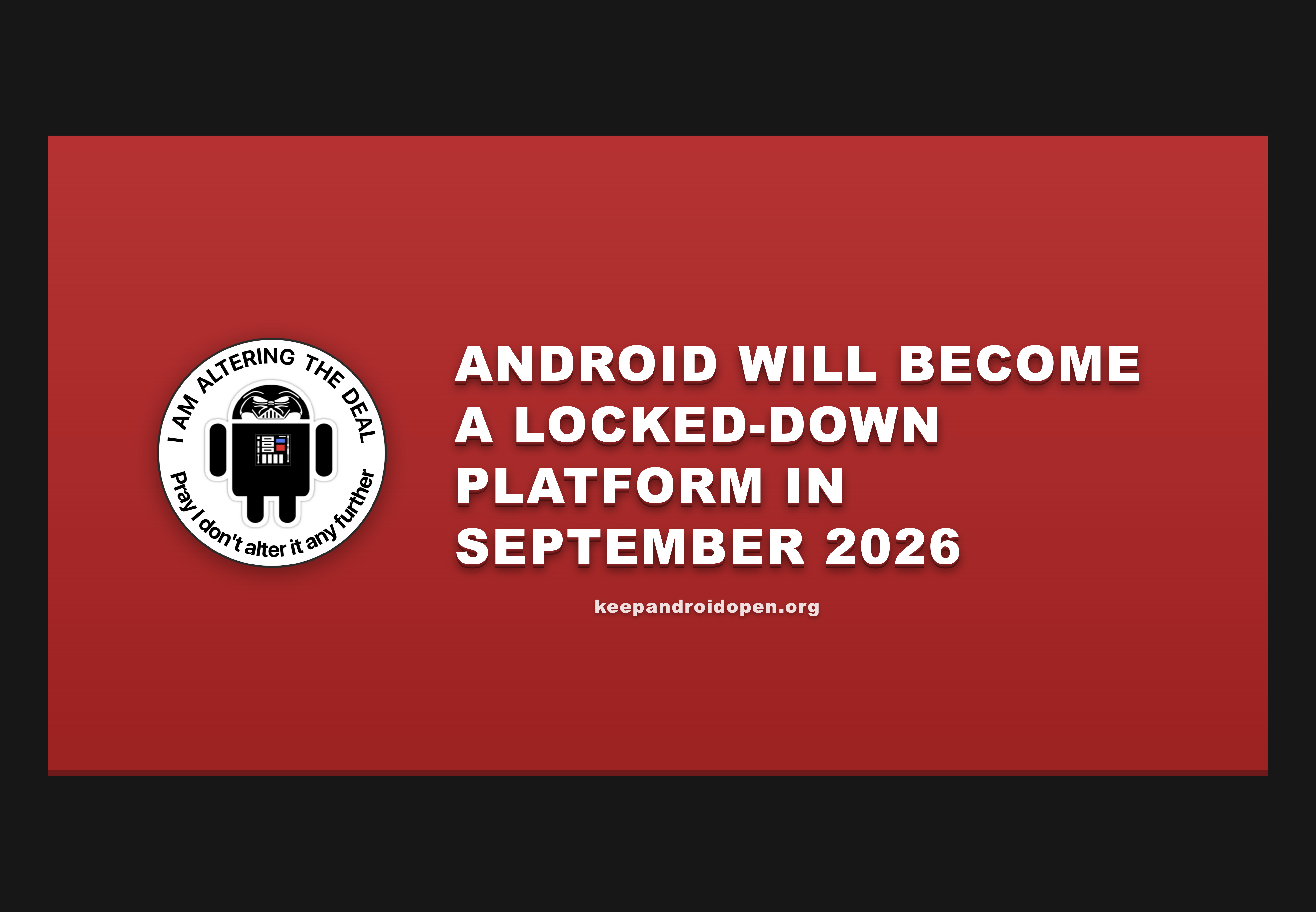
If you haven’t seen this yet, Google is planning to require mandatory developer identity verification for all Android apps, including apps distributed outside the Play Store, taking effect September 2026. This affects every independent and open source Android developer directly.
This is not just about the Play Store. After September 2026, on any certified Android device, applications from unverified developers will be blocked by default. The only proposed bypass, the “advanced flow”, exists only as a blog post and has not appeared in any beta, dev preview, or canary release. No one outside Google has seen it.
The community has been fighting back at keepandroidopen.org:
- Read the full breakdown of what this means
- Sign the open letter (organisations only)
- Contact your national regulators — contacts listed by country on the site
- Add the countdown banner to your project
September 2026 is closer than it looks. The time to push back is now.
verified but still not responsible.
Google: “Only I can make malware apps!”
They’re really working hard at distancing themselves from that “Don’t be evil” motto.
they did that years ago
they stopped as soon as they stopped blocking eleciton denial content YT. they were preparing to support trump with propaganda 1-2 years before his election.
Graphene os announced a partnership with Motorola. My next phone will be a Motorola with Graphene OS.
My next phone will be a Motorola with Graphene OS.
I’m thinking maybe my next phone is a dumb phone that can only make calls and maybe text. They still make those, right?
LightPhone?
Motorola should make their own wallet app that works on graphene os.
Hopefully they launch it before September, it certainly seems like it will take longer.
I’m using a Motorola 5G Ace with /e/ OS and its been a great phone (camera is just OK)
I hope Motorola comes out with a Graphene-compatible phone before September.
What other recourse do we have if they don’t?
e/OS on a Fairphone? Sony Xperia?
People don’t get it: it doesn’t matter Graphene or LineageOS. Its still Android and will still be bound to the same limitations, unless you go fully degoogled which means give up on internet banking, cardless payments and government apps. (And much more like m Donalds app and more… But I don’t care for those)
We need open trust platform not one controlled by Google, Graphene or lineage are just not valid alternatives. We need a Linux phone.
I see this take repeated again and again it is simply not true. LineageOS and other FOSS AOSP-derivatives are the best, most-supported and most-accepted FOSS mobile operating systems that we have available to us. And no, you neither have to give up on contactless payments nor on internet banking or government apps. There are many applications that don’t play nice with FOSS Android, but if you make the effort to choose your service providers with intent, so that they are compatible, then it is very much possible to daily-drive a fully de-Googled phone.
I agree with most of everything you wrote.
But banking apps and government apps is not a convenience, is a requirement, especially because, well, by law, they are required to provide an app and there is no choice around it. At least here.
I could indeed go back to bicycle everywhere I want to go and take in the train, but that is not convenience, that is life, so I need a car.
My point is that Google controls Android, whether they graciously allow us to have our foss Android and recompile it from sources is nice, but we still depend on Google and this is not good.
This is what needs to change, and there is no way around it.
WTF are you talking about?
will be bound by the same limitations
It’s based on AOSP (open source). They can easily fork Android and do whatever they want. Open source means full control over software / OS.
Starting from scratch has zero benefits, and only means the experience is shitty and app ecosystem is nonexistent.
give up on internet banking…
And those apps which require hardware verification using Google APIs are available on Linux? How does this equate to “we need a Linux phone”?
The issue, as you said, is “we need an open trust platform”. The best path forward is we push for that so that Graphene and anyone else can us it.
Giving up all the open source work and app ecosystem of Android is irrelevant and only prevents 99.999℅ of people from adopting it.
I am sorry to say that forking AOSP is not an easy solution.
I cannot talk for Grafene as I don’t know much of that organization, but I have been part of the Lineage Os organization for a little bit as a maintainer, and I can tell you that nobody is actually able to start working on such an effort as an AOSP fork.
I would gladly be happy if such a work would actually be maintained and supported long time, but I’m skeptical that anybody but a big organization has a power and a resource is to do so. After all even Linux is actually brought along by lots of organizations and also commercial organizations.
Yes, we need an open source trust platform, and I believe that is the only real way forward. I would vouch for a Linux mobile operating system, but indeed, air truly open, Android would be good as well.
They’re not wrong.
Of course you can fork and have full control over your fork, but Graphene and company want to be able to keep merging AOSP’s code to keep up with features and improvements.
Merging code from a divergent codebase is harder the more divergence there is, and with big codebases it can easily overwhelm small and medium-sized teams.
It’s the same reason there aren’t lots of chromium forks with manifest v2 support, while it is technically feasible, it requires a bigger effort than most projects can afford.
Keeping an open AOSP fork is not a bad idea, but it’s not clear whether GrapheneOS or any other project will be able to keep up with that workload.
Of course Linux phones require a lot of work too, but it’s work oriented towards making it work instead of towards undoing whatever sabotage google ads to AOSP, so it might motivate more people or be easier to do.
Also, both approaches are compatible.
Linux phones can use waydroid, which depends on AOSP, to run Android apps.
Graphenes is degoogled and can support play services in a locked down environment so it doesn’t have full control of your entire system. Play services is what is expected to be used to do the verification process.
This is the route I’ve gone, also if you think any bank, or government is going to suddenly support a Linux phone I’ve got bad news
Given an open certification process anybody could apply and achieve that, at least in theory. Something that with play integrity you cannot being obscured and proprietary.
So who knows, maybe one day even a Linux phone could. But not unless we get an open certification approach.
What about fairphone? A friend has one and choose the “no google” when she bought it. Works kind of apparently.
Ask you friend if the McDonald app works out of the box.
I know, I don’t care for McDonald app as well, but it’s an easy example of a stupid app requiring play certification to work…
https://grapheneos.social/@GrapheneOS/116261301913660830
Not sure if it applies to users only or to developers making apps too. Anyone knows?
This is a totally unrealted point. This applies to the age verification requirements and not the freedom to install apps outside Google control
We need a Linux phone.
For now a linux phone will still lack native banking apps, cardless payment and government apps. Unless the app can run on a degoogled OS (Graphene, waydroid, etc.).
By open trust platform do you mean something akin to play protect?
Yes an alternative to play protect/play integrity… But at very least not vendor locked
Graphene isn’t a ROM, it is a standalone mobile OS based on the Android Open Source Project. So yes, Google primarily develops it, and has de-facto control. But Graphene is actively working to change that, especially with partnering with OEMs so that they can increase device driver support and give more devs incentive to work on AOSP/Graphene in general. For mobile devices the device drivers are huge, unlike desktop/server linux where MOST (obviously not all) things work.
I beg to defer on the device drivers. Maybe you don’t remember, but it’s been decades before Linux would adapt, reimplement or convince manufacturer to provide drivers for it.
Modems first. Graphics card next. Wi-Fi networks also. Winprinters. They all come to my mind. And it’s only by time and effort that now looks just works everywhere.
And now while graphene indeed is doing a great job that I appreciate very much, at the same time they are not developing an operating system. Google is.
There is a huge effort behind developing a full operating system, and it also requires standardization and somebody who defines what the standards are.
At this point, Google is the only one doing that. And if they go closed doors, no open source AOSP clone could keep up with Google changing standards and still be compatible, which would end up as an incompatible operating system.
My point is that currently Android needs Google, and there is no fooling around. We are years away of being independent from Google, whatever the great effort other developers are doing.
I appreciate everybody’s work and I have been a lineage supporter and maintainer myself.
There are tons of issues that we need to solve to be really independent from Google. Forking he’s the least of those.
People should just stop being so addicted to convenience.
Quit internet banking and cardless payments.
I don’t care for cardless payments, but I do use internet banking, you cannot do without at least here, and government apps too are useful and doing with out is just… Impossible.
Mobile banking is mandatory here, if not able to do mobile banking then you can use non free SMS messages, which sucks.
Government apps mandatory I mean that without, you are cut from most digital government services, which is not practical at all. Survivable, but a pain.
You say non free SMS messages as if it’s otherwise “free”, but the product is you.
Utility or privacy, it’s your pick. If you value privacy more, you won’t give in to utility.
Government apps are the only one I think are hard to do without.
You talk of what you don’t know. Bank apps here are mandatory by law. If you don’t or can’t use a bank app then you can use a SMS verification approach where you are required to PAY SMS that the bank sends you.
Receiving SMS here is free, only those from the bank for verification are to be paid without the bank app, it’s just a scam to force you to use the bank app.
The bank app itself is not a scam like a you are the service approach, and it’s not free either as you pay the bank services with your bank account fees already. Maybe you don’t pay a specific fee for the app, bit you already pay your home banking fees anyway.
Found the swede? 🇸🇪😁
No, sono Italiano… But I guess it’s similar across the continent…
For me its maps. Getting directions is mostly why im still on /e/. I would love a linux phone! But im stuck at the moment.
Well, FairPhone has GPS support on Ubuntu and that opens the world to a bunch of native GPS apps
Note that I haven’t tested this, I’m an iOS user, but Linux with Fairphone is starting to sound better and better. I moved from Android to iOS because Android started feeling so restrictive compared to what it used to be in the single digit version numbers era, it stopped making sense to prefer it over the more convenient OS. Now it seems Linux on certain phones is starting to get usable enough that it can be what Android used to be a decade ago when I still liked it.
Interesting i may have to give it a shot.
Do let everyone know if you do, I think there’s actually quite a few people here who’d be willing to make the change to Linux if the Fairphone is truly as well supported as the UBPorts website claims
100%. I have one app for work that i also need. Do you happen to know if two oses can work on a phone? Like grub allows?
Quit internet banking? That’s the only form of banking available when the banking offices only have open on every other Tuesday, during the full moon between 11-12:30, closed for an hours lunch.
How will this affect MDM-solutions that installs apps from outside the GMS world
IIRC, Google stated that it won’t affect GMS devices, and obviously no effect on non GMS devices.
Is there some sort of in between of GMS and Non-GMS that this could possibly apply to?
It would really be about MDM.
With most MDM solutions there’s an owner app that actually owns the device and can install apps directly.
How familiar with this are you? I’m pretty sure most MDMs have to play nice with the rules set by GMS. There are MDMs made by the OEMs of some HW brands, and they have the system signature in their MDM agent for sideloading, but even then if they’re GMS compatible and not AOSP there are limitations to what they can control from GMS’s influence.
If you use a Google Pixel phone, you’re the biggest chud.
It is, ironically, the only phone were you can install GrapheneOS, arguably the most secure and private phone you can have today.
I never believed that shit. mostly because Google designed and developed the phone and god only knows what kind of firmware backdoors are on any of the hardware.
besides that, any money that goes to google only fuels their thirst for power.
You have a fair concern but I do want to say it is possible to get the phones secondhand. Even if someone does buy the phone just to install GrapheneOS then at least they only get a small purchase vs a lifetime of selling your data and continuing to profit off of them long-term.
I understand that, but even if you buy it secondhand it only enables someone else to buy a new pixel at a cheaper cost to them. if they’re forced to hold their old phones because the market is stagnant, the likely result will be a drop in sales to google.
This is what happens when you don’t have strong competitors. We need to promote more independent OS platforms for smartphones like Linux distros.
AKA: Don’t waste time and energy fighting google, spend it helping GNU phones.
Which GNU project are you buying from/supporting?
Motorola is releasing with Graphene OS soon.
You don’t need to wait for confirmation someone else is doing x before doing x yourself. Take the first step!
In fairness, plenty of actors are taking steps in doing x, aka, mobile Linux operating systems. It’s difficult as fuck, even for those with lots of experience, in ways that primarily boil down to the proprietary nature of smartphone communications infrastructure because of companies that have taken actions similar to Google, and then were supported by overreaching legislation. (From what I understand)
This shit runs so deep and has been running for so long, but we’ve only recently started hearing more about ongoing projects because of the flagrant privacy violations surrounding us. Just because so many of us only recently started paying attention, myself included, doesn’t mean that these solutions are new.
I’m confused about what point you’re making here. @kbobabob@lemmy.dbzer0.com is asking for recommendations. How do they “take the first step” when they have no idea what’s good? Especially when they’re talking to someone who seems to already know which ones are good, and it’s very easy to ask their knowledgeable opinion.
You’re assuming kbobabob is asking that question in good faith, while thenoirwolfess seems to believe they might be asking in bad faith (i.e., rhetorically asking as a “call out” because they assume leftascenter isn’t actually supporting a GNU phone project)
Oh. Well if you’re right, then I just double down. That’s a shitty thing to do. Assuming bad faith tends to be the sign of someone who themselves acts in bad faith. The first comment asked a reasonable question and there was no rational basis on which to assume it was anything other than sincere.
Stop overthinking it. This is a platform for discussion. Let people ask a damn question.
This is called explaining. I think the issue here is a lack of thinking on your part
Indeed, I assumed sarcasm, and replied as if kbobabob was sincere and honestly thinking of supporting a GNU project but would only support whichever ones leftascenter are supporting. My own bias played a part in my interpretation, as I believe that at this point any community GNU project is a worthy project.
Language and emotions are complex aha
I’m pretty unaware of Linux phone projects. Currently on Samsung, but if a good enough Linux phone came along then I’d switch.
Are there actually any projects that are worth it currently? Is it a situation where no one can agree so it’s a fractured space and never really moves forward as a result?
Both are important.
Legal cases create precedents which can be used to fight similar cases in the future.
In bizarre legislation systems like the US and the UK if I understand it correctly. I hope the EU will find some non BS thing to do stopping this crap.
And that graphene os will come to good cheap phones 😬
Every single time competitor appeared, they were ignored. Blackberry, Symbian, Windows 8/Mobile.
Microsoft even tried throwing money at app developers to bridge the biggest gap aka apps, but most companies didn’t even want their money, perceiving porting as too troublesome.
What? BlackBerry was ignored? BlackBerry existed before Android and iOS. It was Android and iOS that killed BlackBerry.
It’s actually a shame, because Windows Phone was actually good. It featured a much more user/task-centric UI, letting users think about what they want to do, rather than which app they need to use to do it. Of course, this was bad for apps’ ability to gain and reinforce brand recognition. So of course they didn’t want to support it.
Honestly this, I thought the windows phone was really good. That said I’ll never forgive Microsoft for buying nokia and effectively killing Meego (yes I know sailfish is a thing but it’s pretty stunted growth wise)
I was a windows phone user and the last Windows version is to blame for killing their phones. They released a half baked platform that literally required SOAP for all network traffic. No raw TCP or UDP access just SOAP… a horrible standard based on XML with like 10x the overhead. 6.1 was probably the best but even that was plagued by compatibility issues.
have you read the process - it’s all about anti scam which is a billion dollar industry right now
https://android-developers.googleblog.com/2026/03/android-developer-verification.html
We are taking about Google. The US tech company that works with the US government(which is rotted to the core now). No matter how noble the reasons they will tell you for this actions, this identity verification will be used for surveillance and control of personal life. This is basically the same thing as with child safety now.
And it can’t be disabled in forks? Or will the google sdk require that from the OS (for apps that use it)?
Forks can disable whatever they want.
But the play integrity API, or safetynet or whatever, can fail you in its security checks, and apps that require them may refuse to run on those devices.
Everyone freaking out when this is actually something you would want as a consumer. 8 want to know who the fuck is making my apps, where they are from, and where my data is going. If you don’t want this. I am guaranteeing you get viruses and shit all the fucking time.
In play store fine, but any other sideload store, why?
No I rightly don’t care wrote it if I can see the source code and verify where all my data is.
If you want to know where where your apps come from then Id suggest you stop downloading from the playstore and start downloading from the sources. Get connected with the community. Learn something. It’ll be good for you
As a consumer I want privacy and freedom, not a monopoly that controls what I can or cannot do on MY device that I bought with MY money. So up until now I installed any app that I wanted and never got any virus ever:) While you might be happy with your data going to google, I’m not.
Nope. As a consumer i dont want one conglomerate to have power to decite what i can and cannot do on my personal device.
It would mean they have 100% control over me as a consumer.
The situation has changed recently.
Google backed down from this being mandatory this week. There will be an option to allow side loaded apps but it will require a 24h delay to enable.
https://www.androidauthority.com/google-android-sideloading-unverified-apps-new-rules-3650343/
Imagine loading a website but you need to wait for 24 hours to be able to access it
adb is notably unaffected by this if i recall correctly - please correct me if i’m wrong
If not now, it will be soon. Why are we pretending they care?
they can’t if your device is rooted or running a different rom
That doesn’t help anyone getting a new device, or if they retroactively brick the ability to root your devices that were previously able. I was going to root the S23 Ultra I type this on, but that is not longer possible as I missed the memo on Samsung flat out removing the ability to do so.
Wait a 24 hour delay? Damn. I heard a month or so ago that they had planned to back down on the strict sideloading ban, and came into the comments to point that out. But a mandatory 24 hour waiting period (something, if memory serves, America can’t even do to own literal deadly weapons)‽ Geez that’s way worse than I was expecting.
Opinions invited.
I currently have a Motorola Edge 50 Neo. It’s a great phone, a little more than a year(?) old. It can’t have LineageOS due to it’s Dimensity chipset.
I’m considering buying a Fairphone 6, then put LineageOS on it.
Is the Fairphone decent? How’s the camera?
Are there any other phones that I should consider (decent camera, will run LineageOS or similar)? Maybe the new Jolla phone?
I am currently using the Fairphone 6 with e/OS and I am very happy with it.
Not a heavy phone user though, as in I don’t really take pictures or play hardware heavy games etc, so I wouldn’t know how FP6 competes on those fronts.
But for everything else it has worked really well!
Thanks for replying. I don’t play games. I’m definitely a light phone user however I like to take photos when I’m out hiking/biking. This Motorola actually takes good photos, even though it’s a “budget” phone, so I’d like something equal or better.
Looking at the hardware it almost seems like they are using the same rear camera:
Motorola:
50 MP Sony Sensor - LYTIA ® 700C f/1.8 Blende 1 µm Pixelgrösse | Quad-Pixel-Technologie für 2 µm Quad PDAF Optische Bildstabilisierung (OIS) 13 MP Kamera mit Ultra-Weitwinkelobjektiv (120° Sichtfeld) Macro Vision f/2.2 Blende 1,12 µm Pixelgrösse PDAF 10 MP Teleobjektiv 3x optischer Zoom f/2.0 Blende 1,0 µm Pixelgrösse PDAF Optische Bildstabilisierung (OIS)
FP6:
50MP Sony Lytia 700C sensor, 1/1.56", 1.0μm pixel size Quadpixel Autofocus, 10 cm minimum focusing distance, time of flight sensor Up to 10x digital zoom Optical (OIS) image stabilization Ultra Wide camera: Image sensor: 13MP, 1/3.06", 1.12μm pixel size ƒ2.2 5 elements Autofocus, Macro Mode, 2.5cm minimum focusing distance, time of flight sensor Electronic (EIS) image stabilization
But I am no expert, I’m sure there are differences due to software.
Ah damn, I messed up the formatting, but I think the info is discernible. They seem to be similar
Hey, thanks!
I didn’t think to check HW specs. Not very clever.
so … thanks. again :))
But not comparing the FP6’s camera with other phones: How happy are you with yours? Do you like the photos?
I’m not one for taking pictures, so I can’t really comment on that, sorry.
What I can say, compared to my previous phone (Iphone 14), is that the front camera is a little worse than that of the Iphone 14. I notice it during Video Calls.
Not camera specific, but it’s maybe worth mentioning that it sometimes also runs into small issues. For example it will sometimes not connect to my WiFi and I’ll have to restart the phone in order for it to connect again. Not a big issue, since it restarts quite fast, but for someone coming from a well established phone brand it might be a little irritating. (And it also might just be a problem for me specifically)
But these downsides are well worth it (for me) in order to have a more privacy focused mobile and also not be supporting big American Tech Companies.
Is the Fairphone decent?
Couldn’t tell you, because they refuse to sell them in my country. 😡
Just rip the band aid off and go for Jolla. Keep your current phone as a backup if some apps break
I’m seriously looking at it now. I don’t give a shit about banking apps or the “socials” so that’s fine. I do want a decent camera though.
Is jolla that good? Paying a subscription isn’t the end of the world to me, as long as they are actually using the money for good, you know?
Define good? I mean if you look at the work they’ve been doing over the past decade, as such a tiny company, it’s objectively awesome (sheer size, but also quality)! But I myself turned away from the first Jolla phones frustrated from all the kinks that were never fixed (in that time frame while that hardware was still viable - some were probably fixed in the meantime, some not). The experience remains a compromise: you get freedom from Big Tech, but you do not get several other things you’ve been taking for granted, because of Big Tech. Just one example, you can run Android apps, but if your phone has a fingerprint sensor (the last Jolla community phone didn’t), Android apps can’t use it. There is the camera issue that I mentioned (Jolla is not a camera company). It’s always something, so you have to be okay with that if you want Jolla or Sailfish OS. But I will still mention that it is the most mature, full-featured mobile Linux out of all the mobile Linux efforts that have sprung up these past years. Jolla was first, and they remain ahead of the curve in this space.
You should definitely consider the Jolla, but cameras are basically never great on degoogled devices, because flashing a new rom also deletes the OEM proprietary firmware, which was tailor-made for that device. What you get instead is a generic software that never comes close to matching the original quality. I think the hardware makers who sell degoogled phones, like Fairphone, would have chance to make good cameras, but none of them have actual years of experience making cameras, as companies like Samsung and Sony do.
Well that sucks, a decent camera is basically half of what a smartphone is. The ARM ecosystem is such trash.
I don’t need fancy processing on my photos as longs as it lets me capture some kind of raw format. For photos that I actually care about the quality, a raw is better anyway.
No offense, but you’re part of a niche audience there. The vast majority of consumers just want their photos to look good (even when good means “not like reality”). “I need it to have a good camera” ia something you hear over and over again when people tell want it is important to them in a phone.
Fuck them. I hope open source / de-googled android can somehow survive this.
I get that you can get around this but there are 2 major problems I see.
-
Google now has a flag on my phone they can control remotely to keep me from accessing the apps I want to use.
-
Alternative app stores like F-Droid will never be any more popular than they are today. This raises the barrier to entry so much that we can effectively consider the open source phone app movement to be dead in the water.
-
They were supposed to fight evil, not join it.
They’ve removed that phrase from their ethos a long time ago
Literally. It was big news.
I know. Some people might have missed that.
Don’tbe evil.Corporate has decided that the rules are too long and need to be trimmed a little.
They were supposed to make all the money by any means necessary as dictated by the capital, and they are doing that.
Regulators won’t be any help - Apple has always been even more locked down than that, and no one forbade it, so how are they gonna stop Google from doing the same? IMO the only way out is to leave Android and turn to Linux completely (that means Linux hardware adaptation layers, no more Android anywhere). Some phones have already been made like this
deleted by creator
Surely this will lead to the balkanisation of Android.
Motorola is going to grapheneos, Xiaomi etc go with their own app stores and so on.Main-line Linux phones are really not the way, at least at the moment. Android is fine, AOSP really is an amazing project and easily one of the most impressive software projects ever advanced by humanity. AOSP-derivatives like LineageOS or GrapheneOS are just as much FOSS as any traditional Linux distribution.
Regulators forced Google to do this lol