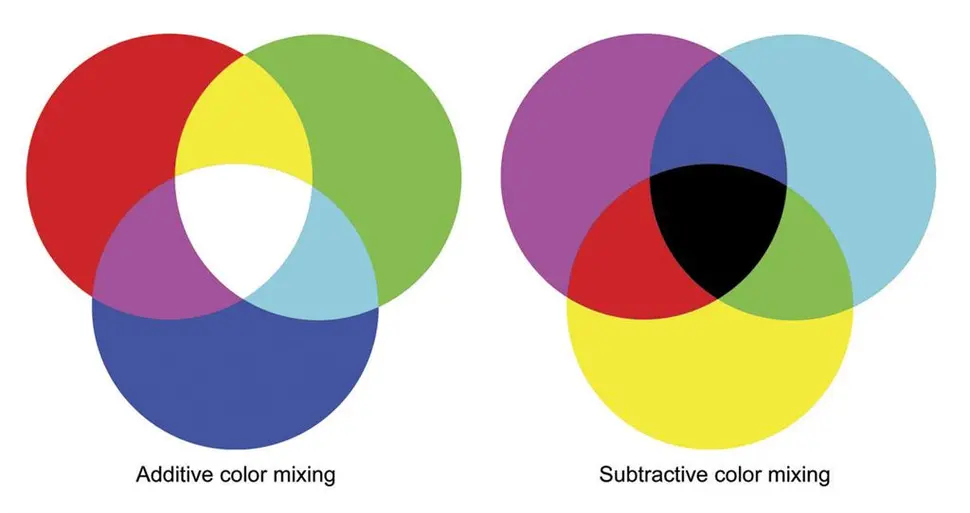
like if you wanted to mix paint to get a color from a computer would you do the opposite of what the RGB value is? I’m confused
like if I wanted to take the RBG code R:99, G: 66, B, 33 wouldn’t it look more lightful than if I mixed paint into 1 part blue, 2 part green, 3 part red? how would you paint a color code?
Basically yes, look up additive vs subtractive colors… that’s why for a monitor you need RGB, but ink cartrages are Cyan Magenta and Yellow
https://cdn.mos.cms.futurecdn.net/6FSgP38XcxfqQuiYicQx5Z-970-75.jpg.webp
In short, colored light, and pigments work in opposite ways. Basically all visible light mixes together to make white light. Blue paint, basically absorbs the red and green light, allowing only the blue to bounce back… so mixing more colors of paint, means less light. until almost nothing gets out (hence black). But on a light source, more colors = more light, leading towards white.
I think the simplest way to explain it is:
- colours in a computer work by adding light. Add enough light wavelengths makes white.
- colours in paint work by taking colours out of the light it is reflecting. Take enough light wavelengths out and you get black
It is the difference between additive mixing and subtractive mixing. When you mix colors on a screen with RGB, you add light. When you mix pigments on a physical medium, you subtract the amount of light reflected (because each paint absorbs most light except the colors it reflects, which are what you see).
As a side note, when mixing in the subtractive color system, your primary colors are cyan, magenta, and yellow. That’s why a printer takes CMYK, for cyan, magenta, yellow, and black. In case you were wondering, ‘K’ here is black.
Great explanation. Thank you.
Can you also tell me how a computer monitor makes Yellow when it only has RGB pixels?
Sure! On a spectrum of visible light, yellow has a wavelength between red and green. Therefore, combining red and green, the average wavelength is the same as the wavelength of yellow. In fact, a yellow pixel is really just a pair of red and green pixels on most monitors (except with certain types of expensive monitors in which each pixel has red, green, and blue instead of red, green, or blue).
For reference:

I hope this helps.
I’ve been wondering - how do you make brown? Don’t really see it on the spectrum.
Dark orange, it’s only brown when contrasted with something brighter.
There is a technology connection video that goes into more details.
K is key. It’s not necessarily black ink, but tends to be when printing on white stock.
If you’re printing on black stock, for instance, you’ll likely have white ink for the key.
Thank you for the correction.
RGB are the base colors for addative methods like light mixing. Think about pixels on a screen.
CMY are the base colors for subtractive methods like paint mixing. Think about printer ink.
CMYK (Cyan, Magenta, Yellow, Key) is for pigments. RGB is for light.
Factoids.
RGB is additive color, best for light emitting displays such as your phone or computer screen.
CMY(K) is subtractive color, the opposite/negative of RGB.
CMYK (Cyan, Magenta, Yellow, blacK) are used as standard printing colors, because they don’t emit light, they reflect whatever light that they don’t absorb.
I mean, you’re almost there, but then you lost the plot. I’m a professional lighting technician, and also happen to have a little bit of experience with paint.
Light is additive color, and RGB is commonly used because your eyes have three different cones that detect colors. You have a red cone, a green cone, and a blue cone. So lights will tend to use the RGB color space because it allows the light to directly stimulate those three cones. If I shine RGB light at a white object, it will combine to reflect as white (meaning the object appears to be white) because the full spectrum is being reflected off of the object.
But the actual colors used don’t really matter, as long as they add up to the full spectrum of light. I could use CMY light instead, and achieve the same basic effect. Again, if the full spectrum is hitting the object, the full spectrum has the potential to be reflected. And that potential is additive color… We add color to the system to achieve the color we want.
Pigment (or really anything that absorbs/blocks light) is subtractive color. CMY(K) is commonly used in printing, but you could just as easily use RGB pigments instead. All that matters is that they’re selectively absorbing light, instead of reflecting it. If a pigment selectively reflects cyan light, (and absorbs all other wavelengths), it will appear as cyan when you hit it with white light. That absorption/blocking is subtractive color. We start with the full spectrum, and remove wavelengths to achieve the desired color.
But the absorption isn’t actually what matters. What matters is that the light is selectively being reflected off of the object. Let’s say I have a pane of glass, which is coated with a special reflective material. This material will allow cyan light to pass through, while all other light gets reflected off.
Now two things will happen if I shine white light at this glass: First, the glass itself will appear to shine red. That’s because when you selectively remove cyan light from the spectrum, it tints red. Since the cyan light is passing through the glass (instead of being reflected) we are effectively subtracting it from the glass’ reflection. So the glass appears red due to the subtractive color.
Second, the light on the other side of the glass will appear to be cyan. Because the cyan light is selectively allowed to pass through that filter. This cyan light could be used for additive color mixing, and could be combined with beams of other spectrums (like magenta and yellow) to form white light.
Now with this above system, we have the potential for both additive and subtractive color mixing, purely due to the properties of how the light interacts with the reflective material. Again, the specific color space isn’t what determines additive or subtractive, it is how the light is interacting in the system. And nearly every natural system will be using both. You’ll have additive color illuminating the room you’re in, then subtractive color selectively absorbing wavelengths to make different objects appear different colors.
Pigment (or really anything that absorbs/blocks light) is subtractive color. CMY(K) is commonly used in printing, but you could just as easily use RGB pigments instead.
There’s a reason CMYK is used for printing. How are you going to mix RGB pigments to get yellow? R+G won’t work. That’s because red ink filters out green and blue light, and green ink filters out red and blue light. So mixing the two you get something that filters out a bit of everything but especially blue, ie. brown. CMY are used for subtractive color mixing because each one filters out just one of the colors we see (C filters out R, M filters out G, Y filters out B) so you can mix them to get most of the gamut you need.
Misinformation and confidently incorrect.
Print is always subtractive. Why don’t you look shit up before posting bullshit?
… because they don’t emit light
As opposed to the posters and paintings that shine, huh?
Yes, I said CMYK print is subtractive, did you read my comment?
You’re close to getting it. You said RGB is additive. Where in print is RGB additive?
Quick crash course, we’re gonna ignore K for simplicity, and assume a basic RGB system. Okay, simplest conversion to CMY is…
C=1-R
M=1-G
Y=1-B
I’m totally skipping over a lot of stuff here, but this is about the simplest conversion for example sake.
Hey dude, is everything okay? It’s just the Internet and just a discussion about printing and colours.
Yeah, thanks for asking. You’re okay with misinformation :)?
As opposed to the posters and paintings that shine, huh?
Wtf are you on about? Those are all like print in that they mix pigments that absorb light. That’s exactly what over_clox said. The contrast is with monitors or displays that emit light, like phones or computer screens.
They’re all subtractive in print.
The person said RGB is additive. Where in print is RGB additive?
You don’t use rgb in print.
Oh really?
Educate yourself https://en.wikipedia.org/wiki/RGB_color_model
Right back atcha bro en.wikipedia.org/wiki/Screen_printing
From that article:
Graphic screen-printing is widely used today to create mass- or large-batch produced graphics, such as posters or display stands. Full colour prints can be created by printing in CMYK (cyan, magenta, yellow and black).
It’s still subtractive.
Exactly. Print is always subtractive.
Very interesting. Doesn’t use an RGB color model though.
Can we all just chill out and have a good [insert time of day]?
CMYK = Cyan, Magenta, Yellow, and Key. Key is almost always black in the print world because printing 100% CMY comes out as a muddy almost black. Having Key as black also allows for better greyscale and higher definition over CMY alone.
K stands for key. Not black. Depending on the color of the stock the ink uses for the key could be white(on black stock.)
Fair point for non-white stock, gotcha.
Deleted by moderator