Many countries include ‘Democratic’ or ‘People’s’ in their names, even though they are not democratic and do not serve their people. Examples: Democratic People’s Republic of Korea Lao People’s Democratic Republic People’s Democratic Republic of Algeria Democratic Republic of the Congo And German Democratic Republic (East Side) in 1949–1990. None of these states are democratic, power and wealth are concentrated in the hands of a small ruling elite. Who are they fooling with these names?
Feat of mental gymnastics. They consider themselves a looser sense of democratic that isn’t a liberal multiparty democracy with competitive elections. With a twist of idealization, they rationalize that their dictatorship of the proletariat headed by a one-party leader serves the people: their bottom-up hierarchy of councils culminates to their single-party leadership whose final decisions (that close discussion and demand absolute obedience) somehow reflect the collective/people. They might call it democratic centralism or dress it up in more elaborate pseudotheoretical jargon.
Marxist-Leninist theory judges democracy by class content, not procedure. The key question is “democracy for which class?” Liberal democracies are seen as formally free but substantively controlled by capital (bourgeois democracy), while one-party socialist states claim to be “people’s democracies” because the state (in theory) represents the working class/peasantry against capitalist and landlord classes. Popular will, in this framework, isn’t expressed through multiparty competition but through the party as the organized vanguard representing proletarian class interests — elections, if held, ratify this rather than allow contestation between competing class programs.
This is in contrast to Liberal democracy defines democracy procedurally: competitive multiparty elections, freedom of speech/press/association, checks on power, peaceful transfer of power. By this standard, one-party states with suppressed opposition and concentrated power fail regardless of their self-description.
So on the naming question, This is genuinely contested. Two views exist:
Official/Marxist-Leninist justification: These states claim genuine “people’s democracy” precisely because it excludes bourgeois parties and concentrates power to defend workers’ interests against capitalist restoration — so from their own theoretical framework, the name isn’t false, it’s just a different definition of democracy.
Critical/liberal view (widely held in the West and by many scholars): The names are propaganda — legitimizing branding for authoritarian, often personalist or elite-controlled, rule with little actual popular participation or accountability.
Which framing is “correct” depends on which definition of democracy you accept as valid — that’s ultimately a normative/philosophical dispute, not a factual one.
This is a great explanation
I feel like I sense AI but it is stl pretty informative
Just because it’s a well-written answer doesn’t automatically mean it’s AI. There’s a couple syntax errors/typos in there that lead me to believe that at the very least it wasn’t JUST a straight up copy/paste from ChatGPT
The EM dashes gave it away. As is common knowledge, those were invented by “Open” AI and are exclusively used by AI. Humans aren’t even allowed to use them.
Bro I use double dashes all the time–often to make little asides like I’m doing right now–and have been using them for years. It was just something I picked up by reading actual books. Now AI comes around and I’ll occasionally be falsely accused as one just because of that one small aspect of my writing style. Feels bad man
It’s a good time to drop them anyway, since it’s usually a sign that you rushed into a sentence without a proper plan. Come to think of it that’s probably why they’re so commonly used by the next-token prediction calculators…
I had to scroll to far to see the actual answer. I get that people hate the answer, but this is the answer.
Love it when someone asks why socialists do something, then reject the socialists’ own explanation for the capitalist propaganda explanation.
You shouldn’t be getting downvoted, you are literally just explaining the differences in how democracy is viewed by socialists.
It’s not getting rejected for being different, it’s getting rejected for being logically unsound
Your lack of knowledge of how socialist governments function does not make them illogical.
good counterargument, the logic makes sense now
“I still don’t get it therefore your argument was bad” lol
Still saying nothing I see.
Ah yes I figure that one party states are very democratic. You couldn’t have more than one communist party, everyone knows that.
You know what a joke you tankies some like right?
Which one of those governments do identify as socialist?
ML is mostly authoritarianism with a smidgen of communist cosplay. It should be called stalinism ihmo, but I think the ‘Democratic’ is similarly applied, as a front that hides the actual fact.
Lol, imagine just straight up repeating lies from the Nazis who joined the CIA after the war and thinking you’re supporting Democracy against Authoritarianism…
I’m begging you to learn something.
It’s getting downvoted for being AI slop (which the author has since admitted to)
I didn’t downvote, but some might have done due to the obvious AI writing style
Is there much scholarly debate on the validity of these opposing definitions? It seems like it’d be difficult to support an argument that the Marxist-Leninist style governments support the working class more than a procedural democracy.
Most of the time they don’t, but In certain cases they can. Yeah obviously North Korea is worse for workers then south korea. But if you look at the current governments of the two superpowers it becomes more contested.
If you look at the government of Xi jinping and the government of Trump, who would you say represents the interests of their people more? Who has higher approval rating in their country, hell who has a higher approval rating globally? Who is enacting more policies that help the people?
Faith in the governments of liberal democracies is near a historic low, people now more then any time since the 30s don’t think the government they voted for represents them. It’s to the point where even the government of Cuba has a higher approval rating then the US government. You could chalk that up to propaganda, but you could probably chalk up the remaining 30% approval of Trump to Fox News propaganda as well.
This isn’t to say I’m in favor of getting rid of procedural democracy, it more often represents the will of the people more then one party states. Just saying it doesn’t always and it’s getting worse at it.
Totally agree that the current US government is shit and getting worse and ultimately it is due to weaknesses in the way the procedural democracy was setup.
To me that fact can be viewed as a fixable design flaw. A Marxist-Leninist system (as far as I understand it) at its root doesn’t seem like a better way to prevent corruption or power grabbing since there’s no built in checks at all. You’re simply relying on the good intentions of the ruling party which, as we’ve seen from all governments, change over time and can be influenced in many ways.
thanks for the explanation
These states claim genuine “people’s democracy” precisely because it excludes bourgeois parties and concentrates power to defend workers’ interests against capitalist restoration
This makes zero sense. If power is concentrated, then it doesn’t represent workers interests. If it represented all workers interests, then power would be diffused.
How are these one-party governments, gauging the interests of their workers? How are they doing this without democracy and voting? Afaik these countries don’t even ask their citizens for feedback
How are these one-party governments, gauging the interests of their workers?
https://en.prolewiki.org/wiki/Library:Soviet_Democracy
How are they doing this without democracy and voting?
They do have democracy and voting and the actions of their government are far more aligned with the expressed will of their people than any Liberal Democracy (which are all just Oligarchies with a veneer of democracy).
https://act.represent.us/sign/usa-oligarchy-research-explained
The first link above is for the USSR, but the soviet (small ‘s’) form of democracy has been used by many communist democracies that the West decries as authoritarian helholes (which generally just means they refuse to bow to the international capitalist order).
The second is for the US but the only difference of you did the same research for any Liberal Democracy would be a question of degree not of substance.
North Korea has democracy and voting? That’s news to me. They definitely don’t have very much. So you don’t think North Korea is authoritarian?
North Korea has a really fucking weird political system but luckily it is not the only country that calls itself socialist. The USA are also undemocratic but you don’t seem to judge all parliamentary “democracies” by one especially bad example
Virtually every country in the world has some form of elections, outside of a handful of literal monarchies like Saudi Arabia and Qatar. What’s more debatable is how legitimate they are and which metrics we use to evaluate that.
Often a country is considered undemocratic if it doesn’t allow international observers, but of course that requires a degree of trust, as it gives those observers the power to delegitimize the elections. Furthermore, the idea that observers from country A would be legitimate and that country B should be expected to let them in already carries a whole bunch of presumptions about which countries are and are not democratic, which winds up being circular. The US, for example, is never expected to invite international observers to legitimize it’s elections.
If you really stop and think critically about how to evaluate elections from the outside, without just assuming the answer based on vibes and presumptions, it’s a very challenging and complicated question. An American may take it as a given that China isn’t democratic while their system is, but a Chinese person could easily feel the opposite. Without establishing clear metrics, it would be impossible to evaluate who is correct from a neutral and objective standpoint. Even if a metric is agreed on, people might have different assessments based on looking at different information.
Personally, when possible I prefer to avoid arguing over it when possible because without establishing a metric it’s impossible to discuss productively, and if you try to establish a clear metric, people will just immediately call you a tankie or red fascist because of course everyone knows bad country is bad, and how dare you try to examine things from a neutral point of view instead of agreeing with what “everyone” already “knows.” I’ve also found that it’s better not to talk shit about random countries I’ve never been to and which don’t really affect my life in any meaningful way.
Having said that, if you’re actually interested in learning more about the subject in good faith, you might be interested in this Luna Oi video where she discusses how the government of Vietnam actually functions and collects feedback from regular people, or the one where she describes how elections work.
This sounds like a great way to erase the definitions of all words. Most times when we use words, we understand that rarely anything is absolute. For example, we call western nations capitalist even though they all have some degree of socialism. Just because there aren’t clearly defined lines, doesn’t mean that all words lose meaning.
The fact that some nations have opaque elections, is actually a strong sign that they are authoritarian. Because suppression of information is authoritarian.
When the US refuses to invite Chinese election observers to oversee it’s elections, is that “suppression of information?” That’s nonsense.
The reason that a country wouldn’t invite observers isn’t that they’re trying to suppress information, it’s that they don’t want to give another country the authority to delegitimize them.
What’s actually far more authoritarian is this idea that every country in the world needs to bend the knee and allow the West to come into their country and declare whether they are a legitimate democracy or not.
Suppose there’s a country that’s a legitimate democracy, but they have such valuable and plentiful natural resources that any major power they invited in would seek to delegitimize them in order to seize control of said resources. Because you assume that they’re “authoritarian” for not inviting in a major power to oversee their elections, you are ruling out the possibility that such a state could exist.
What this means in practice is that you’re giving the West a justification for aggression towards any country on the planet. If they refuse to invite observers, they must be authoritarian and illegitimate, but if they do invite observers, then those observers can simply declare the government illegitimate anyway.
What that works out to in practice is nothing short of chauvanism, imperialism, and world domination. It isn’t a real, objective metric, because it’s only obfuscating the real metric which is just how well a country gets along with the West. A country being on bad terms with the West does not definitionally make it undemocratic, but by your standards it would be.
Opaque elections are a sign for information supression, but not the only sign.
However if I wanted North Korea to be considered democratic, I would first ask that voting be implemented such that voters can’t be identified and punished for voting against a candidate (source)
Luna’s videos have been so informative and interesting. Honestly they kind of make me want to go to Vietnam someday.
I think “authoritarian” is a meaningless designation that only really means “geopolitical adversary of the current hegemon”.
The term came into common usage during the Cold War as a way of conflating communist countries with fascist ones in the minds of Western Liberals.
Authoritarian simply indicates how much power the government has. There’s not a perfectly precise boundary, but you’d have to be crazy to say North Korea has the same degree as France. This sort of “all sides” argument is reductive and problematic.
The DPRK doesn’t put people in prison for having weed and does put people in prison for exploiting other citizens. Both governments have near absolute power, the main difference is how that power is used.
Every state is Authoritarian by that soft definition. That just leaves the question of who weilds the authority and who benefits from it.
The “reductive and problematic” argument here is the pro-fascist talking point that the dictatorship of capital is freedom and anything else is “authoritarian”.
The DPRK absolutely puts people in prison for having weed, are you a teenager trying to be contrarian? Every time you MLs talk you just turn more people off to socialism.
Meanwhile weed is legal in my state, despite the US federal government having “absolute power” according to you.
.https://koryogroup.com/travel-guide/faq-is-marijuana-legal-in-north-korea
If there is no reasonable way for a citizen (as in, somebody not currently part of the government) in the DPRK to influence the laws, then that is what makes it authoritarian. It’s about governance not capital.
This makes zero sense. If power is concentrated, then it doesn’t represent workers interests. If it represented all workers interests, then power would be diffused.
The person you’re responding to’s description is slightly wrong. A “People’s Republic” defines a Socialist state who’s government is made up of an alliance of parties, rather than a single communist party, and that United front government might have parties intended to represent sections of the national bourgeoisie. So there’s a nominal Power sharing element here.
That said, I’m not sure how it logically follows that a state which represents the interests of workers must therefore be decentralized in some way? These places often end up with centralized political systems (though the list of States OP gave is full of a whole lot of variety in their institutions and political cultures), because of outside influence.
The DPRK is like that because some white guys drew a line across a country, and them bombed it until pilots complained there were no more targets to bomb, and civilians began living in caves. The DPRK (and the ROK for that matter lbr) has been something of a basket case ever since. But that’s because power centralization is a response to material conditions, not a result of what someone named the country.
How are these one-party governments, gauging the interests of their workers? How are they doing this without democracy and voting? Afaik these countries don’t even ask their citizens for feedback
People’s Democracies are defined by the presence of multi-party systems, like I explained earlier. Though these secondary, non-Socialist, parties have greater or lesser degrees of importance depending on what country we’re discussing.
That said, there are all kinds of institutions by which a people’s democracy gauges the interests and feedback of the workers and other represented classes.
I’m going to talk about China, even though it wasn’t referenced in the OP, because it’s a People’s Republic, and I can speak to its institutions with the most confidence:
One way class interests are gauged by the state is through the party system. This doesn’t matter so much in the primary legislature, the National People’s Congress, because the allied parties have a small fraction of the seats, but the NPC is historically a rubber stamp for the much more vibrant, body, The Chinese People’s Political Consultative Conference (where the communist party only has 97 seats out of 2,169), where various sectors of society are represented, including parties, ethic and religious groups, organisations in the arts and sciences, mass organizations that represent women or young people, trade unions, etc.
In all state owned enterprises as well as in large parts of the private sector, there are a network of Workers Congresses which allow workers to engage in firm management.
There are also Party Committees in many workplaces, where the communist party itself plays a role in firm governance. These institutions make sure private companies follow the five year plans set out by the state.
There are also trade unions, which represent workers interests in other ways, and have representation in government.
There are also an extensive amount of Worker, Consumer, and Agricultural Cooperatives in China you might find this interesting, as it speaks to your concerns about decentralization. Between State Owned Enterprises, and the private sector that the state is always trying to reign in, co-ops straddle the line between these, by being worker owner and run firms, more independent of state power, and not beholden to the interests of capital like a private corporation.
People are often (sometimes rightly) critical of the privatization of the Reform and Opening up period. But that capital inflow has allowed China to turn around and invest in a domestic cooperative sector that rivals private capital. Huawei is the largest telecoms company in the world, for instance, and it is a worker co-op.
So there are lots of ways that’s workers interests are guaged and turned into an economic plan that will benefit them. Obviously, these institutions have been more or less effective at different times, or in different parts of the country. And a the Chinese system isn’t universal (The DPRK or former East Germany looked a fair bit different to this. While modern Vietnam or Laos modeled a lot of their own reforms off of China), but hopefully it gives you some insight.
There’s another comment in this discussion that talks about how the closest Chinese word for “people’s republic” is 民主 and means government which works for the benefit of the people. So their definition includes a benevolent dictator.
And that seems to align with what you’ve said too. Sure, there may be commissions for gauging the interests of the people. There may be co-ops. But ultimately the CCP holds all power. They can dissolve the commissions if they want to. They can take over the co-ops if they want to. If the people make demands or raise complaints, the CCP can just ignore them.
I think China is unquestionably lucky that the CCP does seem to actually care about the people. But this amount of authoritarianism does not seem to work as well in many other countries.
And if you genuinely think that what North Korea has right now is the best they can do for their people (even despite the turmoil caused by other countries), then we’ll just have to agree to disagree.
There’s another comment in this discussion that talks about how the closest Chinese word for “people’s republic” is 民主 and means government which works for the benefit of the people. So their definition includes a benevolent dictator.
I mean, I guess? I don’t know enough Mandarin to speak on that.
And that seems to align with what you’ve said too. Sure, there may be commissions for gauging the interests of the people. There may be co-ops. But ultimately the CCP holds all power. They can dissolve the commissions if they want to. They can take over the co-ops if they want to. If the people make demands or raise complaints, the CCP can just ignore them.
I think China is unquestionably lucky that the CCP does seem to actually care about the people. But this amount of authoritarianism does not seem to work as well in many other countries.
Look, I’m not trying to argue with you. I’m just answering your questions, and explaining to you what those institutions look like in China. You’re more than welcome to do your own research and come to your own conclusion, but I think you should go into it with a sense of curiosity about the world, rather than trying to get in sick dunks on the internet.
the CCP does seem to actually care about the people
And look, I have my qualms about China’s system too. But they eliminated absolute poverty. Tf are you talking about?
And if you genuinely think that what North Korea has right now is the best they can do for their people (even despite the turmoil caused by other countries), then we’ll just have to agree to disagree.
I mean, the DPRK’s ongoing 20x10 regional development policy is using its new influx of Chinese and Russian capital to improve economic development and living standards outside of Pyongyang. So that’s certainly an improvement.
But that can only to so far when the Korean war never ended. If you actually care about the wellbeing of the Korean peninsula, you’d want the war to end, the US to leave and lift all sanctions, and for there to be an internationally mediated peace negotiation that would decide what peaceful future between North and South Korea might look like. Perhaps an EU style arrangement with open borders between the two countries, and shared economic interests, while each gets to retain their respective political and economic systems, as they see fit.
I’m an ardent socialist. I think the cult of personality around the Kim’s is weird and unhelpful. But my opinion is meaningless in the face of the material reasons why that personality cult exists, and the material solutions that need to be implemented in order to bring peace and prosperity to the Korean peninsula.
And I’m simply sharing what I’ve learned from my research on the subject. Not entirely a direct response to your comment, sure, but relevant enough that I felt like sharing, not just to you but other readers.
you’d want the war to end, the US to leave and lift all sanctions, and for there to be an internationally mediated peace negotiation that would decide what peaceful future between North and South Korea might look like.
Or Kim could give up power and reform the government to a more western style of democracy. That would naturally end the war as well, and probably improve relations with South Korea considerably.
If pressure on North Korea is released, there’s no telling if the authoritarian government would change their ways at all. In fact that pressure might be necessary to push them to change.
Ah yes, just like all the other countries that democratically voted for their own people’s interests. Those were all totally left alone by the US.
Or Kim could give up power and reform the government to a more western style of democracy.
You mean like America, which invaded and destroyed 80% of Korean infrastructure and killed over 3 million civilians? That kind of western democracy? You are the exact same type of chauvinist that caused the Korean war in the first place.
Thank you comrade Deepseek o7
Fair enough, you caught me. Did do some edits but the explanation Qwen gave was way better then anything I could’ve put together, and IMO better then a lot of the other responses here that didn’t give the other side and just gave the western liberal consensus view it gave at the bottom.
It’s called being a “Meat Proxy” and is fast becoming one of the most obnoxious things you can do online. Stop doing it. If I wanted an LLM’s answer I would ask an LLM. You’re not helping.
you’re not helping
Idk see plenty of people saying it’s a good explanation and got a decent amount of upvotes and some good discussions, seemed like it helped the thread to me, which was fairly one sided on the other responses.
If an explanation is good and helps the discussion then why does it matter where it came from? This is from my local model too so there’s no concern about water usage or giving open AI money too. I
f anything it’s better I post it here so everyone can see it as opposed to some people being unsatisfied with the liberal answer and asking Claude themselves, burning more tokens, water etc. for a bunch of people asking the same question.
Because this isn’t supposed to be repository of knowledge, it’s a social place for humans to talk to other humans. You might think it helped with a specific question, but long term you’re poisoning the well, and setting a norm where trust is eroded even further.
The fact that you didn’t initially flag it up as being a clanker until you were called on it shows that you know deep down that it’s not classy.
Deploying a low-effort AI to provide “balance” to Lemmy is not your responsibility, and not something anyone would vote for if given the option. AI output is like farts; people only like the smell of their own. If you couldn’t bothered writing it, then how disrespectful is it to waste other people’s time expecting them to read it?
So I repeat: cut it out, nobody wants Lemmy to be a place where you ask a question and some lazy-ass meat proxy who lacks the intellect or patience to do their own writing, passes it over to an LLM.
Because this isn’t supposed to be repository of knowledge, it’s a social place for humans to talk to other humans.
It can be both, there’s plenty of people posting links to external sources on here. Like if someone posts an article, they aren’t necessarily trying to engage in conversation, they’re just trying to get the knowledge of that article out.
Yeah a lot of stuff on here is more about sharing opinions, and I’m not going to post an AI response to a “what’s your favorite pizza topping thread” but threads like this where it’s more of a matter of fact then one of opinion, AI is fine if it gets the fact right.
you’re poisoning the well, and setting a norm where trust is eroded even further.
You can still trust me because I read the response and made sure that it matched my understanding of the subject. I take full responsibility for the post and if it’s wrong then someone is right to call me out, and I take responsibility for defending it. But no one is calling me out for the facts of the post, only you are getting mad at the origin.
AI output is like farts; people only like the smell of their own. If you couldn’t bothered writing it, then how disrespectful is it to waste other people’s time expecting them to read it?
If this were true then nobody would’ve upvoted it and there would be a bunch of comments calling it low quality slop. Hell the fact a post like this didn’t get hate either from the liberals or the MLs on a topic like this shows it’s quality and nuance
It is the best explanation I read so far. AI seems to be generally good at explaining stuff.
Phony legitimacy
It is usually because whoever grabbed power in that place fooled the people to garner their support, telling them that they would actually become a democracy, socialist, or communist, and then, once they are in power, they mask off and never relinquish that power. Sometimes they may excuse that as a “transitional period” before moving on to the promised state. But those are obvious lies.
There are other reasons, tho, like confusing voters and muddying the waters so the people can’t really know who is actually working for them, or just mockery, like the nazi.
This is why the way countries do elections is very wrong. Votes should not be for parties; they should be for policies and objectives. Then get in power people who claimed to aim for the same policies and objectives, and heavily punish them if they don’t really work towards them once in power.
There’s usually a populist factor that authoritarians use to seize power
Or they swoop in with rizz after the people’s democratic revolution stumbles…
Language is the framework of thought. By controlling, twisting, and restricting vocabulary, high-control systems directly restrict what people are capable of thinking. High-control systems maintain power by manipulating fundamental human biology, cognitive architecture, and language. They actively work against societal advancement because their primary goal is self-preservation and the consolidation of status. High-control systems shut down critical analysis, nuance, and long-term planning, trapping individuals in primitive, survival-driven cognitive states. Learn more and ask further questions here: share.google/aimode/A07xJDl8zEiKH71NI
Since the 20th century, linguistic determinism has largely been discredited by studies and abandoned within linguistics, cognitive science, and related fields.
Same reason nazis put socialist in name but promptly killed off socialists and trade unions.
There was a point where the National Socialist Party was actually socialist. But Hitler and his ilk saw a party with popular momentum, joined it, co-opted it, and betrayed the socialist ideals.
Do you have any evidence for this, because I’ve studied history, and I’ve never read anything that indicated the “socialist” part was anything but a scammy populist virtue signal?
Nope. There never was. They were always faar right. They from beginning were a nationalist group that despised democracy. Even before hitler joined them
I have no idea where you got this from, but it’s totally false. They were never a socialist party. They had some prominent members who supported strong social programs but that doesn’t make them socialists.
Is this Stephen miller or Anton lavey
Close enough. Fetterman. Sold himself as a hard working everyman, but he’s closer to Kid Rock.
Maybe he got some brain worms from RFK. Democrat in name only (DINO).
That term is kind of meaningless these days.
Yes
authoritarians employ the double speak because they are liars at the root of their beliefs
like NATO is an occupying army in the countries they have bases and not a defensive cooperative force
ml’s live in an alternate reality cult
Is all part of the narrative. More they control it, more they look like the “good guys”.
It’s a reflection of the state’s original aspirations—the justification it used to overthrow the preceding authoritarian state.
The problem is, the more significant the social/political changes are that you’re trying to enact—and the more entrenched the preceding regime was—the more tempting it is to turn to authoritarian methods to cut through the pushback. But once you start down that path, the means inevitably become the ends.
Nothing about this is inevitable, use of force does not magically obligated one to continue using force or to use it inappropriately, wielding authority does not magically corrupt people, these are the direct result of material conditions and different conditions can and do have different results
State-scale institutions are always conglomerations of adaptive subsystems (or quickly become so, if they’re not completely dysfunctional). This institutional ecosystem selects for subsystems that use state institutions to perpetuate themselves—and its these systems, not the individuals within them, that increasingly evolve to exploit the state’s authoritarian powers.
Cool story
This is deep man
Branding!
Same reason the USA has ‘United’ in its name.
Or america, it’s just a tiny part of it (and other parts are united too).
Watch Americans get angry when you ask
- “you mean the united states of Mexico?”
- "no, NORTH America!
- “so, Mexico?”
- … 😠😡🔥
If I said “estados unidos” it would be fair to assume Mexico. You’re just being belligerent because it’s currently acceptable to be openly bigoted toward Americans.
You’re just being belligerent because it’s currently acceptable to be openly bigoted toward Americans.
I can be belligerent with or without USians present.
I don’t know what you mean by currently, but I have been critical of US American exceptionalism for a long time. And that includes feeling attacked when someone says “there’s more united states than just the USA”.
I don’t think calling me bigoted is applicable here.
And people downvoting me and even feeling the need to berate me kinda proves the point of my previous comment.“Me intentionally being an asshole and getting asshole reactions means the other people are assholes”
Yeah ok bud, you’re pretty bad at manipulating people but good try.
“bigoted towards Americans” is the funniest shit
I gave you an upvote because while i’m USian, I firmly believe that “American” is a proper term for people of the United States of America.
I also am fine with the folks (mostly Brazilians in my experience) who want to use “American” to refer to people of the Americas (or the continent of America for those that consider it a single continent).
Both work fine.
It’s usually pretty darn clear from context which is meant, just like with Georgia (a US state and the English name for a country).
It’s always clear from context. In English “American” means a denizen of the USA. Spanish and Portugese have different words for that.
You sound like you think you’re disagreeing? Because we agree
Just not leaving wiggle room for contrarians.
Leg of lamb is a dish where one serves a leg that comes from a lamb. The name does not claim that the entire body of the lamb is served.
Yes but when you say leg of lamb, most people don’t give a shit which leg you’re referring to.
There are multiple sets of states that are united under a single national government and are part of the American continents (Mexico and Brazil, for example) but only one of them claims to be THE United States of America.
Only one of them IS THE United States of America. That’s how names work.
Nothing anywhere says “There are no other states that are united in any geographic region that you can refer to as ‘America’”. That’s just silly.
For example: Mexico is Estados Unidos. I like how they actually refer to the US as EEUU to differentiate. See? It works. You can make things work.
Was the USA the first set of “united states”?
if you stick strictly to the name “united states” then yes, it’s the first entity to name themselves this. later entities include the united states of belgium but they appear later (1790).
however, the netherlands used the name “united provinces” and “(republic of the seven) united netherlands” from 1588, sooooo I guess it can count if you make your question broad?
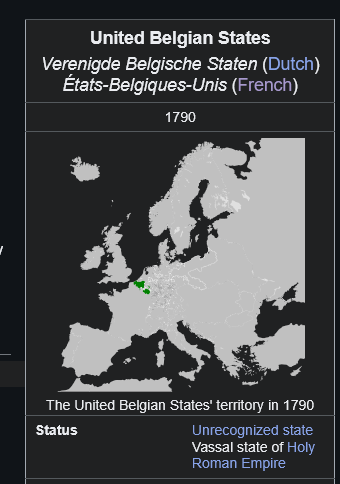
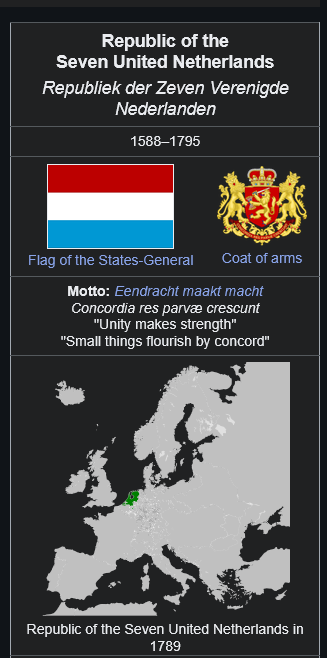
I wonder if the US founders knew about the Netherlands and thus tacked on “Of America”…somehow I doubt it
I suppose it was. Good point.
Come to think of it, what bothers me isn’t our name so much as the attitude of so many of my fellow citizens that the rest of the world is of no consequence. Our name puts a fine point on that narrow world view, regardless of whether it was intended that way.
So yeah, I’d rather see the culture change than the name.
In the Americas, and in the modern period yes, but the concept was not totally new. Switzerland was a kind of federal state since 1291: https://en.wikipedia.org/wiki/Federal_Charter_of_1291
The Iroquois had a league of sorts that could arguably be considered a uniting of states, stone age though the tribes may have been.
“Of” being the operative part of the name. United States OF America. Derivative of the land name given by the European explorers. While it’s incorrect to just say “America,” you’d probably just be considered annoying if you went around reminding people or pretending not to get it.
Luckily I love being annoying.
While it’s incorrect to just say “America,”
No. It is not incorrect. It is simply that “America” can refer to the USA, or it can refer to a continent if you consider NA/SA to be a single continent. Similarly, “Georgia” is a US state but also a country.
Sure, no one means that when they say it though
Unrelated. For many intents and purposes the states of the US are in fact united. However the examples in OP are very much not democratic.
it has a united military
With Israel
And federal government.
Usually, they are rebranding after a revolution with the goal to establish a democratic or communist government. But then the inherent weakness of those forms of government leads to internal instability due to outside influence and/or internal corruption. The new and unexperienced government gets more and more extreme in an attempt to defend or due to simple greed. The original idea becomes more and more distant until not even a faint shadow of it is left.
same reason america espouses freedom but then has 304830483048 laws that restrict every possible thing you can do other than go to work.
Its true when you see some legislation with freedom in the title you know they are about to take someones freedoms away.
Why does trump say he’s “the peace president”? Because they are all evil fucking liars trying to confuse dumb dumbs.
Cause you expect the west hegemonic definition of democratic.
Is there a competing definition of democratic?
The Marxist view is that capitalist countries are anti-democratic because the bourgeois class has the power to both sway elections and exert influence over people’s lives outside of the political sphere. True democracy means a state that actually represents the people’s interests, which in turn requires suppressing the political influence wielded by the rich.
The liberal view is that the state’s capacity for repression is uniquely dangerous, and so freedom just means being able to act without interference from the state (not from private entities), and what determines whether a state is free or not is whether it adheres to certain principles. In that view, a Marxist state that represses the bourgeoisie is violating the principle against political repression, and is therefore not democratic.
On the other hand, Marxists point to things like capitalist states repressing strikes to show that in those countries, the state is also willing to act on behalf of the people who control it, and that that this whole idea of a state being constrained by “principles” or “norms” and somehow being independent of class conflict is nonsense and just not how politics works. This is because Marxists view ideas as being the products of material conditions and material interests, and so any such “norms” or “principles” are only as strong as whatever class interests are invested in upholding them.
bourgeois class has the power to both sway elections and exert influence over people’s lives outside of the political sphere.
That is absolutely a fair criticism.
But is there anywhere doing or attempting democracy by your definition?
Vietnam and Cuba would probably be some of the best examples I think.
You can’t seriously be calling Cuba a democracy.
Vietnam is not a democracy. It’s a single-party state where the Communist Party of Vietnam is defined as the perpetual leadership in their constitution.
Hi, welcome to the conversation, you should probably read the things I already explained.
The liberal understanding of democracy (that you’re operating on) is constraining the power of the state, while ignoring class conflict. The Marxist understanding is a state where the people have succeeded in class conflict to the point that they are able to wield the state against the bourgeoisie, while keeping them out of power. The fact that the communist party has secured power is not somehow a strike against Vietnam, from the Marxist view.
It’s always funny to hear this scaremongering over “one party states.” I live in the US, where I have a choice between one party that represents the interests of billionaires and another party that represents the interests of billionaires but also hates gay people. When I vote for a third party that’s actually in line with my interests, everyone hates me for it. And you know what they say? “The primary is where you’re supposed to choose who you like, but then you have to get behind them, to stop the Republicans!” Well, even single-party states still have primary processes, and in a case like Vietnam, you don’t even have to worry about the threat of an entity like the Republican party coming to power, thanks to the structure of the government suppressing the political power of the right.
If a one-party state is so horrible, it implies that the Republican party (and similar parties in other countries) existing is somehow a good thing, somehow fulfilling a necessary condition for a country to be a “democracy.” Even though it’s controlled by a tiny fraction of society and uses every ounce of political power it has to subvert and oppose popular policies!
With that being said, you don’t even have to be a member of the communist party of Vietnam to run and hold office in the country. You don’t have to be a part of any party, you can run as an independent, and people do.
And yes, ditto for Cuba, I am “seriously” calling it a democracy.
Many, yeah.
https://en.wikipedia.org/wiki/Types_of_democracy#Other_types_of_democracy
“People’s Democracy” is one - https://en.wikipedia.org/wiki/People’s_democracy_(Marxism–Leninism)
In the West we’ve been getting 50/50 splits on voting, whereas out east it’s all 99/sent for re-education. Which of these seems more hegemonic to you?
In the West we’ve been getting 50/50 splits on voting
Close elections are a fairly meaningless metric, especially when all candidates agree on certain key issues.
whereas out east
“Out east?” Where? There’s tons of different countries with all kinds of different governments in what’s classically considered the East. There isn’t even a Comintern to generalize about, but it doesn’t seem to slow you down at all.
Have you actually studied the government structure of, say, Laos? I doubt it. So, where did you get this information you’re confidently repeating about it? Mind-boggling how liberals will just say shit. Lazy stereotyping at best.
Elections≠Democracy. Again, you are expecting liberal west (or hegemonic) “democracy”. I am not making a moral judgement of either, just trying to explain that the definition of democracy that has been shoved to the people’s brain of the global north (hegemony) is not the only or the correct one.
What does hegemony mean here? And what would a non-hegemonic democracy look like?
I mean it in Gramsci’s terms. For the second question I would say the ones cited by OP are good examples but horizontal organization is my preferred one, look about EZLN ways of horizontal democracy. Again not saying they are the correct or morally good ones either.
the ones cited by OP are good examples
How is North Korea a democracy?
EZLN ways of horizontal democracy
These seem to be distributed communities that internally use direct democracy (public assemblies). And I agree that direct democracy is a form of democracy. A very inefficient form that doesn’t scale past the size of Greece or EZLN, but still a democracy.
Voting is incredibly minimal at best but has marginally expanded since 2023 with some primaries.
North Korea is basically if a trauma victim was a country, shellshocked after a genocidal bombing campaign. Blowback Season 4 goes into crazy detail about the war. That’s what caused them to pioneer the tunnel technology we saw in Vietnam and also Gaza today.
Neither of those supports the stance that it should be considered a democracy though…
Unfortunately nuance has no place here, nor does the anti-colonialist context or distinction between party and governance.
It’s an introductory lie. It supposed to get you used to lying.
It doesn’t work on everybody. You must be one of “THOSE”.