

Canada, in a single image? I’ve driven cars in most European countries, Canada, US (small amount), Mexico.
Canada has the worst road designs of them all, though since almost everything here is modelled after the US, I guess it could still be worse there
I regularly see road situations where I can only wonder how high they were, what they were smoking, and where I can get some
Intersections where only one lane has traffic lights, the other doesn’t. How are you supposed to cross that? Simple: you throw a hail Mary, close your eyes, andale a run for it while praying to some non-exist God. This is howy stepson got sideswiped, by a guy having to do exactly that.
Making a left turn in Canada? Great, you got green! Go? Well no, cars are still coming from the other side, they inexplicably got green too so now the intersection with traffic lights also acts as an intersection without traffic lights. Amazing designs!
But wait, there is more!
Once those cars from the other side are gone, you might be tempted to think that you can now just drive, but noooooooh, this is Canada! Pedestrians also got green so now you need to try and avoid those too if you can. The amount of near misses that I’ve had and that I’ve seen with others is staggering, crossing roads in Canada is fucking dangerous.
All this adds up to that going left basically means that you get green light and you can’t do shit until it gets orange, then you quickly squeeze yourself through and pray that you didn’t murder a school class by accident.
This, in turn, means that going to the left is an exercise in patience, because each green red cycle, about one car will be able to go to the left. If each cycle takes a minute, and you have ten cars in front of you, that means you’ll have to wait ten minutes I shit you not.
Compare that to the Netherlands, where intersections get redesigned and rebuilt every time when anyone sees there are tooany accidents, and there are soany amazing traffic flow control designs there. Here in canada, traffic flow designs is “road, done”
I love Canada, I feel proudly Canadian, but Canadian road designs are removed as fuck.
Making a left turn in Canada? Great, you got green! Go? Well no, cars are still coming from the other side, they inexplicably got green too so now the intersection with traffic lights also acts as an intersection without traffic lights. Amazing designs!
Sounds normal to me and I’m in Europe. Unless it’s explicitly signaled with an arrow in the traffic light expect oncoming traffic and of course there are pedestrians.
The thing that you have to keep in mind is that Canadian roads (and, presumably, American roads, too) were designed for a very different transportation culture than the one that exists today. In many cases, they were built for horses and carriages, and retrofitted to motor vehicles that grew up in a much less populated country. No, they didn’t work well in the 50s, either, but the density of cars was low enough, and the kinds of people who drove were different enough, that it kinda sorta worked. But as the populations have grown, and as the culture has become more high strung, and driving has become a necessity for many people (and as vehicles have gotten larger, taller, and more fortress-like), navigating the streets has gotten riskier for all involved.
And no, it won’t get fixed, because North Americans hate change, and we would rather give a small number of millionaires and billionaires tax cuts than actually spend money on social infrastructure in any kind of meaningful or thought out way.
When you do the math on how much it costs both a private citizen along with the public to enable cars as transportation it’s mind boggling.
The province I live in makes around $90-100B / year in tax revenue, and spends around $4.5-5.5B / year on roads and road maintenance.
There’s also the hidden cost of road work caused by utilities being replaced, struck, or newly installed. We pay thx bill for that through our telecom, power, sewer .etc
Insurance, gas, car payments…
If a road is built to last 10 years then technically on average you’re replacing ⅒ of your roads every year. Utilities are the same and trenching/patching is horrible for roads necessitating rework on them earlier than the life expectancy. A fiber line might have a 40 year life span, but installing it turned a 20 year road into a 10 year replacement.
Oh, it’s worse in the US, but it also varies wildly by State. Boston roads are defined by the most negative possible combination of local knowledge, horse buggy trails, and fuck you. New York? Turn lanes can fuck right off, let’s make sure one car can block an entire lane of cars trying to pass by. Also, let’s cram as many secondary roads into one short highway as possible that is the only way to go a certain direction so that it’s at a near standstill for 15 hours a day. Make sure it’s under construction for every 9 out of 10 years. Oh, and that’ll be $8 toll for the luxury of the experience. Texas? Make each direction on a highway 6 lanes wide with everything from scrapyard clunkers and 10 foot tall brodozers going 80 mph, and they‘ll shoot you if you say anything. Midwest? Hope you have good suspension to cope with all the potholes and missing chunks of bridges. California? 14 lanes wide and at a dead stop in traffic.
Inaccurate. It’s two cars with 1.5 car lengths in front of each.
You’re right, this is worse.

So close. The first car is too close to the line.
I drive to patients homes all day and I daily see people in the suburbs stop far enough back that they don’t always trip the left turn arrow, sometimes leaving that lane stuck an extra cycle. It would be infuriating, except that my drive time is paid and mileage reimbursed, so I’ve chosen not to let it bother me. I just roll my eyes and wait.
Generally when approaching a intersection on a red light you should stop the car so that you see the white line at the top of your hood. This allows you to also see the painted crosswalk and any pedestrians in the crosswalk (no matter their height) when sitting in your car.
If it’s a two lane or more roadway it also has the added benefit of letting the driver to your right see pedestrians more clearly if they are making a right turn.
The person to your right can pull up to and have their front wheels touch the line, while having a full unobstructed view of the intersection to the left, it also allows a pedestrian crossing to see the car in the far right line as they approach the end of the intersection.
no
At least here in Austria we often have left turning lanes, that have a magnetic sensor/loop in the street and the traffic light only switches, when you’re on top off it.
People stopping way too early and especially people leaving too much space between cars is really infuriating in the city…Those sensors are the apex of Modernist arrogance, where people just decide they know every detail about any system they look at and can control everything.
There is no single place where they work. But at least people have been steadily removing them for the last 30 years.
I’ve noticed more and more what look like cameras/infrared sensors on traffic lights instead of induction loops, much more “fault tolerant” and work much better for cyclists.
I’m not really sure, if I understood you
In streets with high traffic, the left turning red light only goes to green, if someone is actually there waiting. Because else it would make a longer red phase for the opposite drivers going straight
So, it seems like an improvement to me
What am I missing?
What am I missing?
Every traffic situation where people would need to cross but there won’t be a car stopper exactly over the sensor.
Not exhaustively:
-
pedestrians
-
motorcycles
-
bicycles
-
cars stopped at the wrong place
-
As an aside, are there real L-shaped traffic light stacks? I’ve always seen them with the arrow at the bottom. The direction of the arrow makes it perfectly understandable without putting it off to the side. But I could imagine a traffic light company marketing these.
Depends on the country. I’ve only seen these.
It’s informative in that you can guess what the extra light is even when off.
I guess, but in my experience there’s red, yellow, green, and any extra bottom one is an arrow.
With us, it can be an arrow right, an arrow forward, a light saying bus, a bunch of things
Idk, my city in UK has those, though it’s usually backwars L for left turn.
I’ve noticed a lot of little routine things in UK are different from US where I live. I really wish we had more roundabouts here.
I live on a street that’s got two roundabouts. It’s a residential area and people really don’t know how to use them. If you don’t signal, nobody knows what you’re doing. Please signal. I’m begging you. It’s not that hard.
Strong UP ARROW on this one!
I like them.
My wife gets to anxious about them. Like nobody is in the circle and she comes to almost a full stop, and cars behind honk. i explained to think of it as a 4 way yield sign.
To which she said “What’s a yeild sign?”
Ah, so that’s the issue 😀
Germany:

This would be much less of a problem if fewer people insisted on bringing their whole living room everywhere they go.
Americans have to have large cars because they are always 2 paychecks away from living in them
Prime candidate for a roundabout conversion.
Prime candidate for a bus
the nightmares of being European raised and trying to drive in Sarasota Florida’s roundabout system
I’m curious, what’s up with their roundabouts? Did a little searching on the web but only found some complaints about bad drivers.
people stopping on the r’bout, or trearing the entrance like a stop sign when theres no traffic, there being concrete dividers between lanes on some, some reduce the number of lanes from 2 to 1 halfway around them
The problem with roundabouts in the States is that a large percentage of drivers were never taught how to navigate a roundabout we were just given them with an implied “you’ll figure it out.”
Where exactly are those cars heading? There’s no road forward and only one lane to the right.
Turning left.
The comic definitely made it more confusing by choosing the main (non-intersecting) road of a T junction to illustrate this. In most countries, if this road splits into two lanes, the left-turning lane would split off, and the right-turning lane would go straight.
Edit: Apparently, this style of junction is more common in the US. In Europe, I’ve only seen this kind of junction on highways, but that would be without traffic lights and with a much longer turning lane.
I mean, it’s just a comic, not a rendering drawn by a traffic engineer. There’s plenty about it that isn’t quite right, but it gets the point across so there’s no need to nitpick it. (Source: I’m a traffic engineer, among other things.)
And not signaling. That tracks.
Man, I could have saved like ten, or even fifteen seconds if the infrastructure was bigger.
Fantastic! You have a source?
Just look around.
Thanks Ants. Thants.
I’m missing something? I was hoping for a link to the artist’s site
I think it was a joke: reality. The source is reality (around us).
This is just one more instance where riding a motorcycle is nice. See also, parking.
Contrary example: all the dipshit drivers on the road and nothing between you and their vehicle.
Yeah, but they are fat and slow and very obviously out to get you. You’re quick and nimble, just stay the fuck away from all the other idiots.
Works on a motorcycle too.
The risk of becoming a meat crayon on the pavement is very real, but fortunately for me childhood trauma has given me an enormous appetite for risk and I feel most alive sitting atop an engine with wheels hurling down the highway with the risk of death or dismemberment lurking in my subconscious.
Or walking, or cycling, or taking a train.
My bicycle is my most used form of transportation. I bike around 5K miles per year, more than I drive. If If it’s too far, my next choice is my motorcycle. If it’s really far, there is inclement weather, or I need to haul a significant amount of stuff, it’s my car.
That lawn on the right won’t plow itself, amirite?
Just one more lane bro! That’ll get rid of the traffic bro!
Texas agrees:
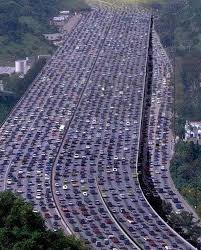
Is that actually real
Yes, Murica!
Texas The Katy Freeway, boasting a jaw-dropping 26 lanes, is the widest highway in the world, found deep in the heart of Houston, Texas.
Can somebody tell them that that’s not how cars work
Them: I know we need a tunnel!
Read a book a few months ago by Tom Vanderbilt called traffic that was an academic look at the titular traffic and it showed negative returns on adding lanes.
Can you summarize the gist of it? I keep seeing this claim and it is extremely non-intuitive.
Supposing it’s true, how is it we’ve magically arrived at the optimal number of lanes as of the uttering of the statement?
If it’s a basically linear function where the lowest traffic is near-zero lanes, is there an implication that mass transit would be built in tandem with lane reduction, or does everyone just get more miserable?
Edit: I’ll add that what I’ve heard is that more people choose to drive until the misery-equilibrium is reached. So roads will always be as busy as they are now because they are at their max tolerable level of drivability. That seems plausible for some roads and for some finite number of lanes, but not generally applicable.
You’d be surprised by how widely applicable it is, it works for virtually any road. Small city roads, highways, even residential streets.
There also isn’t a maximum number of lanes for this effect (well, there technically is, but it’s too large to be feasible) because cars are an extremely inefficient way of transportation, so they take up a lot of space.
Roads also become increasingly more expensive with each extra lane added, to the point where it becomes economically impossible to keep adding lanes. You also need to demolish buildings if the road was already too close to them. And the cost of the extra lane isn’t a one off, it also generates a running cost for repairs and inspections.
That money is better spent on making viable alternatives to cars, which actually will help traffic or even fix it.
Essentially you need all streets to be serviceable by trucks, ambulances, etc., and therefore the general minimum is 1 lane. As you add car infrastructure, it becomes relatively more convenient to drive to a destination than take other modes of transport. You are also typically investing in the car infrastructure at the expense of alternatives, a straight opportunity cost and a sort of spiralling trap, as development becomes more and more centred around the car.
Braess’s paradox outlines adding a route can actually worsen overall network flow, and more broadly, new capacity just attracts new drivers until congestion returns to roughly where it started. Suboptimalities like the accordion effect are compounded as more traffic is added to the system.
Induced demand doesn’t imply the current number of lanes is optimal, just that expansion tends to be self-defeating.
Lane reduction alone would just increase misery, so the answer is redirect road space into transit, which absorbs displaced drivers at higher capacity. Otherwise it’s just misery.
I have a civil engineering degree with a focus on transport but never really used it for that, so this is something that I was taught, but had over a decade to devolve more into opinion.
Lane reduction alone would just increase misery…
Agreed, mostly. In my neighborhood (Grid system) they updated the 4-lane roads in the area to 2-lane roads with center turn lanes. It’s made traffic much better, simply because there’s no traffic waves created by people lane changing around people turning left.
This is why commuting on a motorcycle is so nice. In this situation I’d just filter through the cars and into the turn lane.
In my experience the turn lane doesn’t have a hard cutoff like that, you can usually ride the shoulder a bit to get around people if needed
Where I live the only place you’ll find a shoulder is on the Autobahn and there are no traffic lights on the Autobahn.
So your one of those drivers, huh?
And some people make it a sport here! Zooming by on the shoulder. For…waaay too long.
deleted by creator
I was this person once. I think it was around 2015 I got stuck at a left turn light that puts you on the exit ramp to the interstate. I had only had my license for a year (if even that) and couldn’t tell where the sensor was. I’d keep getting blinking yellow lights, but traffic was a lot coming the other way so I could never go. I kept feeling as I scooted up I was getting too close to the cars crossing the intersection. I swear I was there for like 10 minutes or something.
Is that how traffic lights work in your area? Like they don’t cycle at all when you’re not on the sensor?
In theory, it’s an efficiency measure.
If there is a main road with higher volume, various side roads and no other bottleneck down the road that needs to be accounted for, it doesn’t make much sense to regularly interrupt main road traffic if nobody else needs the intersection. Conversely, depending on the interval, the side road drivers may have to wait a long while if they just barely missed a green.
Both of these cause traffic risk as well: Firstly that the main road driver who decides the red light is stupid and cuts off a side road driver they didn’t see, secondly that a side road driver who barely missed green doesn’t want to wait and tried to squeeze in before main road traffic picks back up.
Having the traffic lights switch on demand reduced those risks: Main road drivers who know that it’s red only if there’s gonna be some other car may be less reckless in running it, while side road drivers don’t have to wait as long and don’t feel the need to squeeze in.
Of course, it can’t ever remove the risks entirely because humans are what they are. It also depends on people actually driving up to the point where the sensor detects them. If they don’t know about the concept, they’ll have a hard time understanding what’s wrong. I was taught those things in driving school, but if it’s not a thing in your area or wasn’t when you learned, chances are nobody told you about it later.
depends a lot, but yes some lights are like that.
In my area the sensor turns on at (???) some time at night. Otherwise it always cycles. At night though, if you aren’t on the sensor it will skip.
Check for cops.
Hop that fuckin curb.
In australia, anyone with an SUV or Ute (~Half of road users) would just pop up onto the nature strip and cut thru to the turning lane - but only if its grassed and not paved.
Yea destroying the infrastructure we all share and need in order to save 10 seconds is super cool.
Fix the infrastructure
I’m not qualified for street construction.
Our society doesn’t give a fuck about me. I don’t give a fuck about it.
Oh no one car length of wait time
you mean a complete light cycle. at that point it dossent matter if they are one car length from being able to be in the right only lane, they might as well be 10 cars back
Valid point and raises the need to be closer to a red light 😄