I was thinking about the phrase ‘The pot calling the kettle black’. It comes from a time where cooking was done over open fires and cookware would become visibly ashy. (Fun fact: It first appears and was perhaps coined by Cervantes in Don Quixote!)
What are some other idioms that have lost their literal connection to time? What would be a good modern replacement?
To be honest, I was never prepared to know what “hoisted by one’s own pitard” meant, and knowing today, I still have no clue how this was ever relevant to any time period.
A pitard is a timed bomb used to to blow down a door or wall. The idiom is about blowing yourself up mistakenly instead. Were people using these routinely at some point?
Britta will explain: https://youtu.be/KuuafUtVte0
Yup.
Like that one scene in The Two Towers when Legolas suddenly became unable to shoot his bow.
before the invention of doorknobs, doors were indeed single use. they would be blown open with every use. this is why we invented chamber pots. midnight bathroom breaks were very loud, before people had pots.
I would like to subscribe to your history newsletter.
So is “hoisted” in this case the equivalent of “yeeted”?
Ain’t no two ways about it
Blowing up or at least weakening a portion of a castle wall during a siege would be useful to the besiegers. Even a small petard could break into a building for nefarious purposes. And being a sapper is notoriously dangerous even now.
Of course Shakespeare could have used the name of a larger bomb, or “speared with his own sword” or something. But Shakespeare’s audience would also have clocked the fact that pétard is a French pun from péter which makes it a fart joke. And he never missed a chance for a fart joke.
They don’t need to have been used routinely, just knowledge of their use had to be common. In the same way that “shooting yourself in the foot” makes sense even to people who have never used a gun. It was enough to know what “hoist” and “petard” meant to piece together the intent of the phrase. Then once the phrase itself became common the specific knowledge was no longer necessary.
A stitch in time saves nine.
This refers to a time when clothes were hard to come by and often homemade. If they tore, a small tear could be fixed with one stitch of needle and thread, but if let go too long, it would take many more stitches to repair a bigger rip.
Change your oil (or tires) in time, or change your car.
This is still relevant, please take care of your clothes.
went from hell and back, obviously it has a very christiany origin to it as is moving heaven and earth.
Eating a dead horse - not unless you buy the budget beef mince at Tesco
Read like rabbits - rabbits can’t read or even hold books
Nip it in the butt - that’s sexual assault, you’re not allowed to do that any more
Get down off your high horse - you’re not allowed to get animals high either
Kids should be shorn and not herd - goats have hair, not wool, and can’t be shorn. Their natural tendency to herd is a difficult behaviour to break.
Under the weather - unless you’re a pilot you’re going to be under the weather most of the time
A blessing in the skies - unless your bishop is a pilot too, that’s not going to happen.
Fight off more than you can chew - I don’t know where to start with this one,
You almost got me.
I always thought it was “nip it in the bud” where a bud is the early stage of a plants development / before the flower emerges on a flower. So meaning “kill it before it grows larger and that becomes harder”

Has to be trolling because they are all wrong.
Under the weather is right.
Boneappletea
surely there’s a /s or a trollface i’m missing
I was half expecting that to have been posted by LadyMondegreen
I’m not pulling your Greg, if that’s what you mean.
You leave my Greg alone. He’s perfectly capable pulling himself & if he needs help I have gloves!
“pot calling the kettle steel” just doesn’t have the same ring to it.
I mean black is still a common color for cookware though
(to do something) “on your dime,” i.e. at your expense - A reference to public coin operated phones, which for a long time cost 10c/a US “dime” coin per call.
Inflation by the late 70s had made the single dime call a thing of the past, but USD20c was still possible, and inflating phone fees in the 80s required increasing amounts of coinage. Public pay phones were decimated when mobile phones gained popularity and are virtually extinct today in the US.
“on your card” might be a more modern version, but cards are slowly disappearing with NFC phone payments.
Similar to when you “drop the dime” on someone, i.e. using a dime to call the cops on a payphone. Although in my lifetime, I don’t think I’ve heard anyone but Bradley Nowell use that phrase.
Ohhh, that’s where “dime you out” comes from.
On your tab.
“Picking up the phone” makes sense because you will probably pick it up to answer or dial. “Hanging up the phone” doesn’t really happen so much anymore but we still do it all the time.
“Have your cake and eat it too” doesn’t really make sense. Cake is not rare or expensive enough that simply possessing it feels good. If you have cake, all you want is to eat it.
The italian version, “you want a full barrel and drunk wife” illustrates the same situation much more clearly.
When I was a kid, I remember asking my mom about this phrase because it made no sense to me. Why in the world would one even want a cake if they weren’t going to eat it? What is the point?! (I have always been particularly fond of cake — eating it, that is — who cares if it’s pretty if it tastes good?)
According to legend, some people have what’s called “deferred gratification”, by which they drive pleasure out of knowing that they will get to eat the cake later.
I don’t get it either. I think it’s a myth.
But maybe you will someday in the future…
But I want it now!
Just desserts is another one.
That’s because it’s backwards. Should be “eat your cake and have it too”
Ted, is that you?
Thank you Unabomber
Even flipped, it’s still weird in English with “Having cake” meaning “Eating cake” in most contexts anyway.
Better stated as “… and still have it”, come to think of it.
this actually finally makes the phrase mean what it means without a bunch of explanation
Also wanting to eat your cake and have it too is supposed to imply you’re like a toddler having a tantrum because you’re just coming to terms with the rules of object permanence: a person playing peekaboo or hide-and-seek can disappear and still come back, but if you eat your cake it will be ALL GONE!!!
There’s a reason that is seen as greedy and foolish.
Mouselemming thank goodness you’re still here. I scrolled up and you disappeared for a second, I was so worried!
You cannot have a cake in your possession and also eat that cake. Once you eat it, it is gone.
I cannot possess cake without eating it
Technically its not gone, just inside you.
Oof ouch my bone satchel
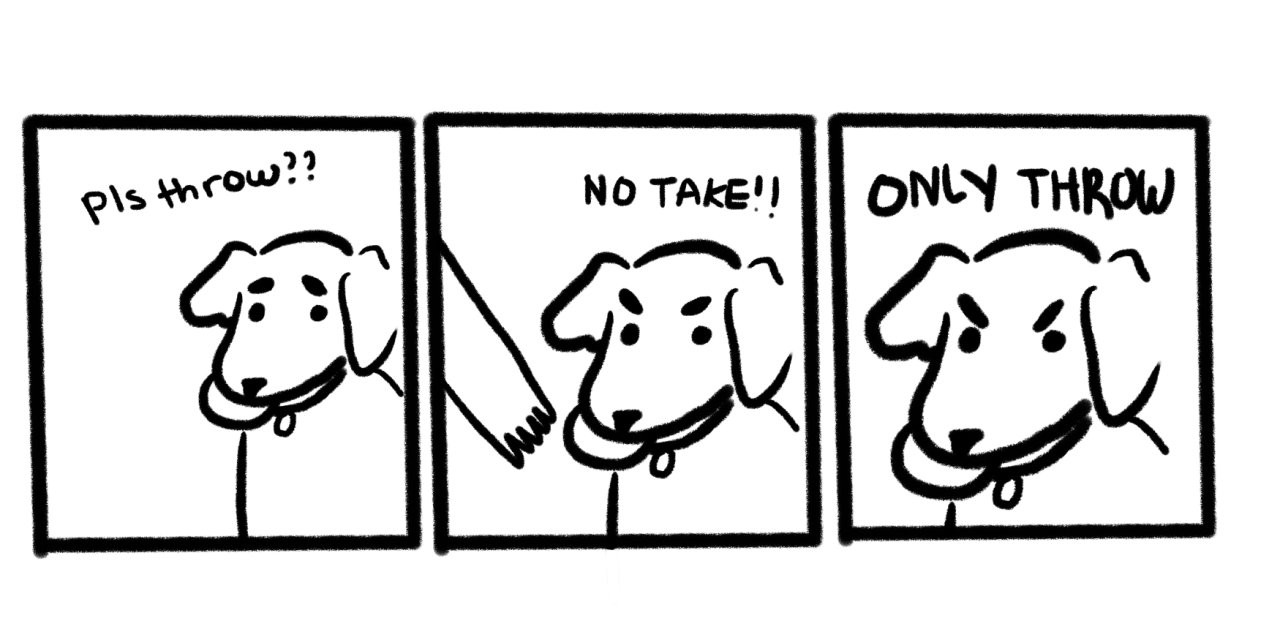
I’m only half joking when I say this could be the modern replacement. I’ve caught both myself and the S.O. using “no take only throw” in conversation, often about unreasonably demanding people.
I was confused by this one too, but then I thought about it in the context of a wedding cake; you want to have it as a beautiful thing to show off to all of your guests, but you also want everyone to enjoy how good it tastes as a desert. You can’t have both simultaneously, so you have to pick
Ted Kaczynski has entered the chat.
Dollars to donuts originated in an age when a dollar could buy a considerable quantity of donuts. Inflation has since reduced the literal interpretation of the expression to nearly even odds.
In 2026 it’s literally Donuts To Dollars.
Time is a flat, fried, circle drenched in chocolate frosting and filled with cream!
Chocolate-flavored frosting
Also donut shops overcharge. Donuts used to be super fucking cheap. That’s why they’d be next to the coffee pot at every function, and in the work break room. Now they want like $2 a donut. It’s dough that’s been boiled in grease. And they get to reuse the grease for many boilings. C’mon.
I’d bet you dollars to RAM…
Also, I enjoy etymology. To me donuts will always be doughnaughts. (Naught meaning nothing or zero. Essentially zeroes made of dough.)
I came here for this comment. Thanks OP.
In my home country they say “Cheap as Onions” (eq in English : Cheap as Dirt)
Looking at the prices on Onions nowadays …
In Italy, when something is expensive, we say that it’s salted. Because salt was expensive. Hasn’t been for a while but the word is still there!
Same in Germany
“Worth ones salt” is older and sort of Italian (Roman)
“Did you bring the (evening newspaper) with you?” I’ve used this in different countries, the newspaper referred to is one which historically was sold in the afternoon, not morning. And I ask it of anyone who comes to work late. Now, at least here, all the newspapers come out in the morning, so I just get confused stares.
That sounds like a great candidate for a modern replacement if I’ve ever heard one! What’s something that you can only get at night these days? Seems like everything, especially information, is 24 hours now. Maybe someone more creative than me could chime in?
There’s tons of replacements, they’re not directly equivalent but equally snarky: “Hey part-timer” “Half day?” “Stop by for some coffee?”
Hurried right over after dessert, then?
Well, you’re early for tomorrow!
I’ve heard some variations on that before.
“Extra extra read all about it.” Said because it was an extra leaflet to the daily newspaper published later in the day.
I love head over heels as, in love.
It’s vice versa that makes actual sense, but that was considered too obviously risqué in the age the phrase was coined.
My head over her heels ( ͡° ͜ʖ ͡°)
Not quite updating, but in my house we say “like sweeping the yard” to indicate that something is pointless and wasting time.
“Boss has us doing obviously pointless busy work today”
“Yeah, next he’ll be having us sweep the yard!”
Or derogatorily:
“I want you to go do that thing.”
“Sure, you want me sweep the yard when I’m done?”
With the invention of leaf blowers, “sweeping the yard” is real! Or at least for literal yards …… I have no idea in your industry
Raking the forest
I saw this as a screenshot somewhere today, I think it kind of fits the theme: https://www.threads.com/@beaukorylak/post/DYez23dDppv
I don’t think it’s the char/open fire but rather that both pot a d kettle would be made of the same black cast iron
Alternatively, shiny kettle and the pot sees its own black reflection in it.
(But yeah, I assumed they’re both black/cast iron)
I think the outdated/obsolete nature of terms in many idioms is what makes them charming.
It also makes it pretty clear you aren’t using them in a literal sense. If your idioms are too new/unfamiliar and your terminology is too modern/relevant then people might just think you’re being literal and not idiomatic.