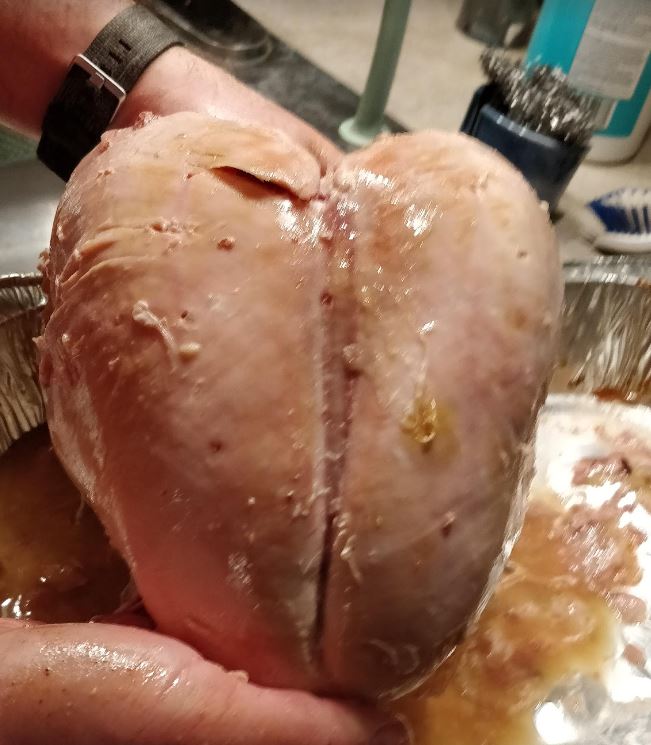
Haaaaaa. C’mon Deutschland, its a funny phrase. We don’t need a lesson in pronunciation.
In Estonian twelve months is kaksteist kuud
Sounds like “cocks taste good”.
We’re all allowed to enjoy the penis humour.
That’s the thing though. The sign says something like “we’re sooshan deesh”
The phrase is funny when you anglicize the pronunciation. Is this really a comprehension issue?
BuT tHaTs NoT hOw YoU sAy It~
Ya… everybody knows. I really didn’t expect the conversation on this joke to be so divided, but I guess the Germans are living up to their reputation for their sense of humour.
You are just envious that they have Suchard chocolate in Switzerland.
Reminds me of Djengis Kahn - Moskau https://youtu.be/rFUloAg1iXk
Moskau, Moskau, hahahahaha!
For more musical goofiness involving Russia, check out Boney M. - Rasputin (also from Germany.)

To be fair that song is a Disco cult classic. That bassline goes hard.
The Germophiles came en masse to correct the translation. I guess they were “suchen dich”, op.
I really lost track of what’s going on in this thread anymore but I give you 1 gold sheckle for a hearty chuckle
We’re suckin dick 🫵
There is a “20 bucks is 20 bucks” joke in here somewhere
Knowing the German pronunciation makes it not as funny. But seeing “extra dick burgers” at the store still gives me a chuckle.

Why are Americans literally seemingly physically incapable of pronouncing words like “suchen” and “dich” in the proper way? Of course I am biased as a native german speaker, but I swear, those sounds aren’t that complicated to make?
The problem isnt that they are complicated to say but that german and english use different letter and phonic pronounciation. So without any german lessons an english speaker wouldnt be aware of that.
I never knew the Germans were so open about fellation.
They’re not, but it’s the wurst kept secret in all of Europe
I should have known Germans are all about sausage.
Isn’t it closer to “we are looking for you”?
If you take it literally, yes, but it is usually used in a hiring context.
Thanks. I wasted a year on Duolingo and got very little idioms, just some supposedly common sayings like das is schnee von gestern, oder es kostet nur einen apfel und ein ei.
Honestly, ich_iel has done more for my understanding than Duolingo did, but it is still almost nil.
Careful, Zangendeutsch is a trap for English speakers. Like, not an intentional one, but you have to check the vocab you pick up there.
I’m still working on my die/ der/ das ‘s
suchen = to search/look for
and ch doesn’t make a k sound, not even close.
I’m fairly certain the German ch sound doesn’t exist in English
Made even worse by the fact that depending on the word it can make two different sounds and neither of them exist in English
In some areas people pronounce an initial ch as a k, like kina instead china. But apart from that neither of the two actual ch sounds exists in English.
Und often enough, ch is pronounced (t)sh, like China, duchess, choose or Apache.
Aaah, thanks, I had a hard time to figure out what is supposed to be funny here.
and ch doesn’t make a k sound, not even close.
Go back to school.
I just so happen to have passed by one of my old schools, what should I do next?
This is about German, not English
It is about English, because the whole joke is how it sounds in English.
deleted by creator
Yes, such as in the word school .
I see. So it’s kina, dukess, koose and Apake? Gotta have a word with some english teakers, brb.
deleted by creator
the statement you replied to was about how ch sounds in german though
Unless you’re a Berliner, but then you have to wonder why your baked goods are talking, and why they insist on being called Pfannkuchen instead.
Well it is close, though. A velar fricative versus a velar plosive. Both unvoiced.
deleted by creator
That’s not a valid comparison at all, and it’s not pedantic to point that out no matter how preemptively you claim that it is.
Bilapial ≠ lapiodental! It’s not that hard to understand.
The entire similarity between K and the German Ch is based on them both being velar (and unvoiced). You’re crafting a strawman by focusing on the “fricative and plosive” manner while ignoring that the sound is made at the same place.
S and T are almost a better comparison because they’re both technically alveolar, but that ignores the fact that S has a dental component. Try making a T sound and then an S sound without moving your teeth. It won’t work.
In Dutch, a T is sometimes pronounced S
Politie (police) is pronounced polisie for example
In the word politiek (politics) it remains a T sound
Democratie -> democrasie
Etcetera
That’s like saying F is close to P
Korean for example doesn’t have an F sound, a lot of loanwords that have an F sound use P instead, France turns into Prangseu and coffee to copy.
Coming back to this thread, because sometimes it actually is pronounced as a k
e.g. Fuchs, Lachs, wachsen
tbf, it usually is not a k, and most importantly it isn’t in this context
Yeah, but only in combination with an s, so it’s chs that’s pronounced as ks.
We’re sucking dick?
Aah no its german, sorry.
Must be a case of this superior sense of humor that we Germans famously do not possess.
“ch” is sometimes pronounced “k” in some languages, but then it’s quite rare
After considering the issue for a while, I think people just really really want to see dicks everywhere
Happens often in English even if it isn’t the default. Chasm and school for example.
people just really really want to see dicks everywhere
For that, all you need to do is to turn on the TV and watch any news.
I wanna be suchen big dich too but my wife is not really too much into it.

Delicious warm cock? Sign me up!
Oh, this must be so funny when you are monolingual and have no idea how to pronounce German