For those say in their 60s or 70s here. When you were in your 30’s or 40’s did you have the feeling that the world was a fucked up place? So much has been going on since I entered adulthood in the early 2000s and I feel like it’s getting more and more intense. It’s never ending.
Is it unique? Or has it always been this way?
Always has been, the big difference is it wasn’t streamed straight into your eyes in real time
Yep, only in my 50s but this is correct. All the shit under Reagan, Nixon etc, decades of meddling in the middle east before that. A century of oppressing South America. All the labor struggles. It’s like the increase in the diagnosed cases of autism. The number of cases didn’t increase. Only our awareness.
Yep, you had to get out of bed, and walk a few miles, if you wanted to see public torture and humiliation of others.
But executions and all that were public events. Not behind closed doors like today.
The world is just as fucked up as it ever was. The only difference now is that every fucked-up thing that ever happens anywhere is getting pushed to your always-on doomscroll device in real time with people attaching their mostly ignorant opinions to it.
This is where the “touch grass” advice comes into play. In broad terms, the real world is not the hellhole social media portrays it to be.
My always-on doomscroll device’s weather app today told me about an aviation accident that killed two people in another country
I just wanted to know if the snow was going to let up, why am I getting international news of death and dismemberment?
I’d get a new weather app that only shows the weather. If you’re on Android, try BreezyWeather (F-Droid link).
The FDroid one only uses OpenMeteo as the source (which is pretty good) but the releases on Github offer additional sources. Not sure why there’s a discrepancy, but I use the Github release and Accuweather as the source (YMMV which gives the best results for your area).
I’m not that old…
But you’re confusing reality for perception.
The world’s been fucked up, it’s just people can see it from their phones when they used to not even hear about it
Being aware of issues doesn’t make them worse, just means we have a shot of fixing them.
OP keep this in mind.
During and 18 month period in the early 1970s there was an average of five domestic terrorist bombings in the US every day. Think about that… five a day was the average.
Ah, that does warm my European heart.
The world is on fire, climate change looks to be a thing that will just happen, wars, everything getting more expensive with no hope in sight… but at least the US has less bombings!
I get that things have been shitty all the time, but generally the direction has been towards better things. I dunno if we reached a point where things are as good as it gets and getting better is more and more difficult, but I personally feel that things are in some sort of a turning point. I know I’m a grumpy fuck, but I’ve really tried to always look on the bright side of life (whistle) but I haven’t really found anything worth looking forwards to. Plaargh.
According to legend, the problems all started when the landlord found out that Adam and Eve had a pet snake, and they got evicted.
It was worse. The difference is that now companies are making money off of scaring you with headlines so that you will click, click, click …
No, no it was not.
Example: when they found out what caused the hole in the ozone layer, they fixed it.
If we found out now, people would say that you can’t trust Big Academia or Big Science and nothing would be done. And don’t get me started on vaccinations.
We’re sliding rapidly backwards.
People who say it isn’t are just too lazy to do anything.
Stopping climate change is ORDERS OF MAGNITUDE harder than protecting the ozone layer. Protecting ozone requires switching the chemicals we used in refrigerants and propellants to other, viable alternatives. That affected products worth, generously, maybe 1% of GDP?
Stopping climate changing the vast majority of the vehicles on the planet, along with the majority of our electrical power plants. It also necessitates stopping deforestation and overhauling a wide number of industrial processes, including for basic materials like steel and concrete. And that’s not even getting into methane emissions from livestock.
All of these things add up to a massive chunk of the planets GDP. It’s an extremely heavy lift, and it’s not fair to say that the world has gotten worse because we’re struggling more with climate change than the ozone hole.
No one could see the ozone hole. We had to believe science and everyone did.
meanwhile climate change is not just easier to understand, but becoming apparent in everyday life. There’s been an overwhelming consensus in science for half a century. How do people still doubt? Or what kind of hatred could make you actively resist changes to mitigate it?
I feel @starlinguk@lemmy.world was saying more than that. I don’t recall any serious studies or news articles suggesting the ozone hole was a hoax or that debunking a human cause. Although it was kinda an aside but the anti vaxine thing he points to. I mean one of the most effective medical interventions since soap and sterilization has people acting like its some sort of evil witchcraft that will actually harm you despite the clear evidence both clinical and personal to its effectiveness.
But there were a lot of news articles suggesting at that time that global warming was overrated.
But at that time the science was just solidifying so overrated was not that contrary to say its overrated or inconclusive or something. Its like at one point there was a microbiologist that thought hiv was a passenger virus and did not cause aids. Which at the time was reasonable given koch’s postulates although they are basically impossible to apply to aids but eventually we had some much evidence built up that it became moot. Which is very similar with global warming. Someone might say we don’t know enough or have done enough studies and that might be reasonable in the 50’s but becomes silly by the 90’s
I don’t know of any for the ozone hole specifically, but you can look to the fight over cigarettes to see the same science-denying approach during the 50s and beyond. That was literally the blueprint for climate change denial by the fossil fuel industry in later decades.
I think that is an apt comparison and it just outlines the things to me. We really did not know smoking was bad till the 40’s and the 50’s is when it was much more conclusive and the industry was able to push off legislation for like a decade into the 60’s. The greenhouse effect although known for awhile similarly did not really become conclusive till the 50’s and still it was like the late eighties when congressional hearings brought it more into the us public sphere although many folk still did not really know about it till gores 2006 movie put it more into the common culture. The industry fud started with the congressional hearings when there was indication it might lead to regulation. So they have pretty effectively stalled it for the most part for over 30 years! In addition we have had some regulation and then had it pulled back. I think it really highlights the decline compared to before when you look at cigarettes compared to greenhouse gases.
I guess. You could also look at things like plastic pollution where industry straight up won, and during the 60s-70s successfully pushed the responsibility onto consumers to recycle while continuing to crank out single use plastic with very few restrictions.
I don’t think the industry did much there. Consumers were not exactly avoiding plastics. There was kinda a few attempts to avoid them but they did not really go anywhere except for maybe the reusable shopping bags. I have to say I used to love and get the 16 ounce pop bottles that had the deposit that you got back when you brought them back. I would be buying them now if the pop industry had not phased them out. Was still able to get them even in the first year or so of the 90’s. That ones a hard comparison.
My local grocery carries deposit-bottle drinks of some varieties (mostly milk and soda, both of which are produced locally, sometimes tea and other drinks), so they are still around in some cases. I’m also a big fan of grolsch beer because it comes in nice swing-top bottles that are great for use as a home brewer, or for making sauces or whatever you may like them for. The beer itself isn’t that good imo, but it’s basically free with the purchase of bottles, as that’s basically the cheapest way to get swing-top bottles of that size.
Very importantly, only the one grocery store carries the glass bottle soda, though there are 4 others within a 10-minute range. So it’s entirely possible that there is somewhere near you that has it and you just aren’t aware of it.
At least in the US there are more trees now than when the settlers landed at Plymouth Rock.
I find this hard to believe.
It certainly is, but it makes sense if you know about logging practices.
Generally, logging companies will cycle through parcels of land and replant parcels that have been clear cut so they can have guaranteed lumber in the future without having to negotiate new leases and such.
And with the massive amount of protected forests, the places they’re allowed to cut is way less than it used to be.
I mean maybe. If you count little seedlings or such. there was this thing about how a squirrel could go from one ocean to the other without ever touching the ground. I mean the logging practices prior to the settlers landing on plymouth rock were pretty anemic. I mean the natives had few buildings. All our towns and cities and buildings in general were for the most part forest or prarie and even prarie had trees especially long water sources like lakes and rivers.
I mean the natives had few buildings.
You’ve been told a racist lie. Native Americans – especially ones in the forested parts of the country – had plenty of agriculture, and at its peak in the 12th Century, Cahokia (the largest city we know about north of Mesoamerica) may have had a larger population than London or Paris did at the time.
What actually happened was that the natives caught old-world diseases from the earliest explorers and colonists, which set off a continent-wide pandemic so virulent that, by a few decades later when the European settlers really started showing up in earnest, something like 90-99% of them were dead and their towns had been reclaimed by nature.
Two things:
Native peoples very much built buildings.
Lots of where towns are now in the south and in the plains weren’t prairie as is commonly thought, they were lowlands populated with bamboo.
ok. So just to be clear we just care about if there are technically more trees like saplings in tree farms than any type of environmental thing yeah?
TIL not all bamboo is from Asia. Is there a good/easy way to tell Arundinaria apart from invasive bamboo? There’s a vacant lot near my house with a ton of bamboo on it, and your comment gives me a slim hope that it might be something other than a noxious weed that needs remediation.
People said the same we can’t fix it about the ozone layer.
But it was still done. Regulations were put in place and corporations were made to comply.
Tje only place that still happens is here in Europe, and I’m afraid that might begin to deminish soon.
You must realize terrible stuff was happening over that time period too. Yes, there is a ton of regression happening right now, but compared to any other time in history some things are better some are worse. One can probably select any two points in modern history and say the same. There are always great and terrible things happening.
I think it depends how we slice it. last century compared to previous. yeah will take this century. this quarter century to the quarter century before. Ill take before. I mean if we are at the tail of of a falling post world war 2 blip that is not a great thing.
It never was, but there were always doom and gloomers saying it was.
Not an old person. But so to put into perspective:
My maternal grandmother was born in war-torn China after the japanese imperilists wrecked our country. Food was not even a guarantee… farming sucked…
My parents were born during the cultural revolution… the way they described stuff… all they had to eat was 番薯 (sweet potatoes?)… they say my generation had it better off…
I remember rations were said to be a common thing…
By my era, I had stable access to food. I remember being so picky and they scold me for me… “back in my day… all we had to eat was…”
I wanted more things to play with… its responded with… “back in my day… all we had to play with is…” (don’t remember the answer but they played with like rocks or sticks or strings or stuff like that)
Literally… all the food would’ve been a luxury in their era…
So like… in a way… westerners having access to food is already not bad…
I mean y’all are not being invaded by imperial japanese…
y’all not being bombed by russians in Ukraine…
y’all not being bombed by israel in Gaza
so…
(I’m not saying you should accept status quo, just trying to think positively by looking into how bad it could get…)
-From an American Citizen originally born in China in 2002
Edit: I also wanna mention the problem with people who grow up under these conditions… they had to deal with so much “real issues” that the whole topic of mental health is never a thing to them… “just get over it” as my parents say…
UGH WTF…
So yea… the west have mental health acceptance… so consider yourselves lucky…
We didn’t start the fire was written for this exact reason. Billy Joel was talking to someone 20 years younger than him who said that when he was 20 more stuff had happened than when Billy Joel was 20, so he just started listing all the stuff that had happened before he was 20 and then expanded it into the song.
If only Fall Out Boy wrote the update better.
This is actually one of the best times in human history.
Exactly how?
Pick a metric of badness like rates of war death, childhood mortality, communicable disease, or extreme poverty.
They’re all low now compared to most points we can estimate in human history. Look at an interval of a decade instead of a year to smooth out spikes from relatively small events.
Over half a million people have died in the Gaza and Ukraine wars, and that’s terrible. It seems like now is pretty bad as far as war goes. World War 1 killed about 20 million. World War 2 killed about 80 million. The perspective is staggering.
A couple centuries ago, half of all children died before adulthood. Now it’s 4.4%. One in 20 children not surviving their childhood is certainly tragic, but far less so than one in two.
All people will die, so does it really matter if its sooner than later? When the prospects of actually living are under the global control of the few? Their chances of having food, a stable climate, and freedom are getting reduced every year? When they will likely face servitude to those with wealth, a surveillance state, mass incarcerations, and if lucky simply become a wage slave?
Twenty years ago I might have agreed with you based on statistics. Now I don’t think so.
Since you mentioned infant mortality, for the first time in twenty years the rate is getting worse. Worth noting that in the US Mortality rates are especially high in states where laws were passed to restrict abortions after overturning Roe V Wade. In Mississippi there was actually an emergency declared when the rate nearly hit 10%. It skews the statistics, but the point is that people are making horrible decisions.
This is not the US alone, although they are leading the way in misinformation, anti science, and populism for power. Its a global phenomenon, and does not bode well for people at all. Diseases are coming back, war is back, and the consequences of global energy and food dependence are extreme compared to the past.
Globally, it is estimated that about 7 million people will die prematurely every year from air quality alone. That means in just 3 years, more people will die from breathing than in WWI. And we are not doing anything about it, in fact globally it is just getting worse.
We have breached the boundaries of climate change, freshwater use, ocean acidification, and biological diversity. There has never been a worse time on the planet than right now.
Edit: this doesnt even begin to cover the issues of chemical persistence or plastics in nearly everything including our bodies. Nevermind PFA’s and other forever chemicals.
Part of the issue isn’t necessarily any one of these things, but seen as a whole, there is little to no will to fix it. Profit matters, and those with the most profit are setting the rules.
All people will die, so does it really matter if its sooner than later?
I think most people would rather die at the age of 90 from heart failure than at the age of 9 from smallpox.
Their chances of having food, a stable climate, and freedom are getting reduced every year?
Those are valid concerns, but the trends were moving in the right direction until recently. I’m concerned about backsliding too, but it’s not clear whether we’re seeing a long-term reversal or just some turbulence.
We have breached the boundaries of climate change, freshwater use, ocean acidification, and biological diversity. There has never been a worse time on the planet than right now.
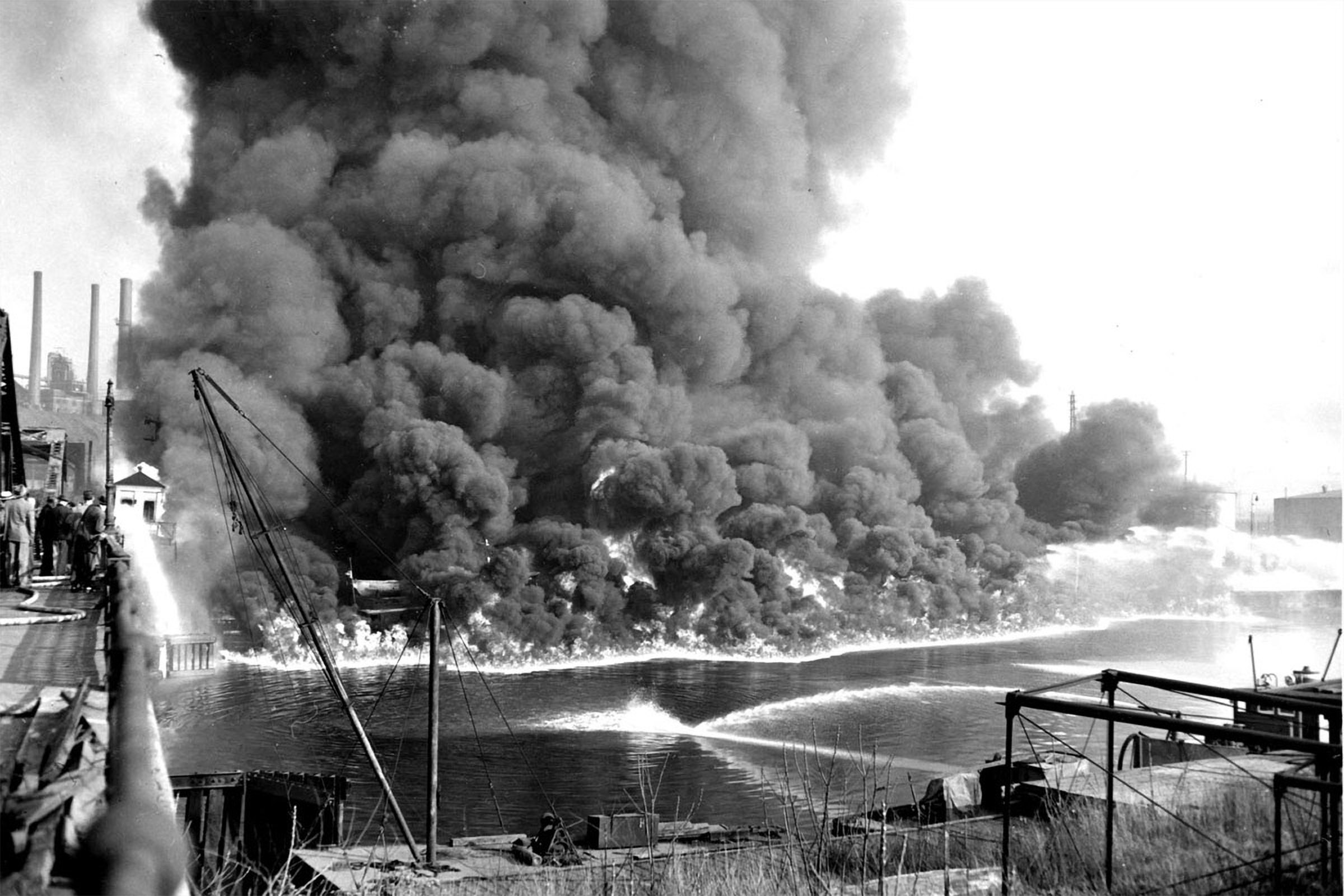
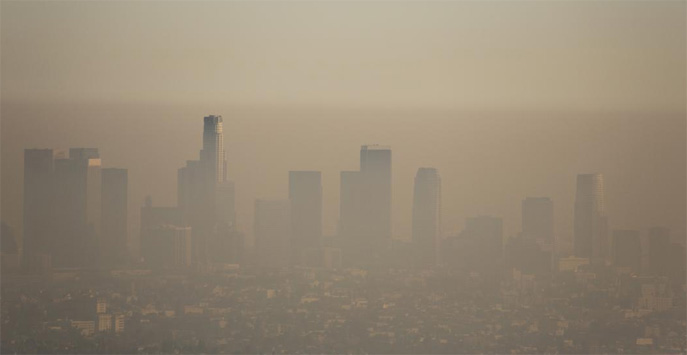
This is a picture of the Cuyahoga River on fire in 1969. Here’s a look at the air in Los Angeles in the 1970s.
We’ve come a long way on environmental protection in the past half century. We still have a long way to go, and as with other issues, there has been some backsliding. I’m pretty optimistic about the long-term trend.
Not anymore. Conflict around the world has statistically shot way up. There’s also a significant increase in political polarisation around the world.
If you’re comparing to a decade ago, yes. However, even with the increased number of wars, it is still more peaceful than before 1945.
You’re right on both counts.
Like most things though it depends what metric you’re using.
Access to medical care for example is better than its ever been.
Access to medical care for example is better than its ever been.
Only in specific parts of the world. Other parts have always been behind, or straight up non-existent, and in one country access to medical care is actually getting worse when it really has no reason to.
I question that. In colonial times and in tribal times, there were huge amounts of conflicts. And conflicts is only a tiny part of how the world is running. Slavery, human rights, minority treatment, just laws, poverty, standard of living, etc. On average world wide, we are far better off. The majority of the people in the first world have luxuries that only kings and nobles used to have.
Those conflicts didn’t have drone strikes though
Between the end of World War 2 and 2016 the world has seen a steady and significant decline in global conflict.
Immediately after 2016 that statistic has been shooting upward rather steeply.
As a little preface here, I teach philosophy and world religions at community colleges for a living, and so I spend a good bit of time reading texts from ancient cultures.
The relevant thing here being that it’s pretty common to find writings from just about every point in human history that talk about their own time as one of terrible injustice, iniquity, etc. often in ways that sound like they could have written today.
So, I’d wager it’s always been this way, and not just in the last century.
Those ancient writings. Were the times and cultures full of justice and equity and they writers are just whiners?
Maybe it’s my anarchism showing, but I’m not sure there’s ever really been a society full of justice and equality, or at least not for long.
So I mean. They had a point then is what im kinda saying.
My take is that everything was worse back in the day, except for two things: climate change due to an unprecedented rate of global warming, and the ability to bomb ourselves out of existence with nuclear weapons, which simply did not exist before 1945. I worry about the first more than the second.
The creation of the universe was a mistake. It’s been downhill since the big bang.
This has made a lot of people very angry and been widely regarded as a bad move.
—Douglas Adams
It really depends on how you define it. There have always been locations and groups where things were terrible and there have been locations and groups where things were good. Often the locations were the same but the groups were different.
In the US, there was a general sense that things were gradually improving that may have gone back as far as World War II and lasted through the 70’s. Not that there weren’t a lot of problems, just that society seemed to be recognizing and working on them. The conservative resurgence in 1980, lead by Ronald Reagan and Newt Gringrich, pretty much ended that positive trend. Since then we’ve seen active efforts to divide people, to encourage prejudices, and, especially, to destroy the education system. That last is critical, because it makes propaganda and other forms of social manipulation far more effective.
The US is now living with the result of allowing those changes. There are vast disparities in education, wealth, and power across the population. Many people on the low end of those distributions have been convinced to blame other groups that are also on the low end. That has allowed those at the high end to corrupt our political and economic systems to their advantage.
The current situation is not sustainable, but it will do incalculable damage to hundreds of millions of people while it exists. And we don’t know what will follow it.
There is strong evidence that humans became successful as a species because of their ability to put interests of the group before their own. Those instincts have been subverted, but they are not dead. That is what gives me hope for the future.